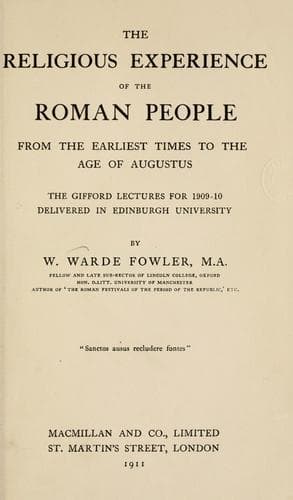
The Religious Experience of the Roman People: From the Earliest Times to the Age of AugustusFowler, W. Warde (William Warde)
Religion
The Religious Experience of the Roman People: From the Earliest Times to the Age of Augustus
Fowler, W. Warde (William Warde)
Cults -- Rome; Rome -- Religion
But how did these writers come by such legends, which, as Dr. Frazer
shows, are to be found also in Greece and in other parts of the world?
Why should they have wished to make Roman kings into magicians?
Rain-making we can understand at Rome,--it had a practical end in view,
the procuring of rain for the crops,--but why lightning and thunder,
which were so much dreaded that every bit of damage done by a
thunderstorm had to be carefully expiated by a religious process? Rome
is not in the tropics, where rain and thunder so often come together,
and where an attempt to produce rain by magic might naturally include
thunder, as in some of Dr. Frazer's examples from tropical lands. I
entirely agree with the latest and most sober investigators of Roman
ritual that this kind of magic is quite foreign to Roman ideas and
practice;[95] there is no vestige of it in the Roman cult; these stories
must have come from outside. And there is every probability that they
came from Etruria, where the lore of lightning had become a
pseudo-science, a waste of human ingenuity, for the origin of which we
must look, as we are now beginning to understand, to Babylonia and the
Eastern magic.[96] The Jupiter Elicius of the Aventine had nothing to do
with lightning; he took his cult-title from the rite of _aquaelicium_;
but as soon as the Romans began to interest themselves in the Etruscan
lightning-lore, of which this electrical magic was only a part,[97] they
perverted the meaning of the epithet to suit their new studies, and
began to attribute to their legendary kings powers which properly
belonged to Etruscan or Oriental magicians. The second century B.C.,
when Piso wrote his _Annals_, is exactly the period when we should
naturally expect such studies to come into fashion, and with such
perversions of "history" as their consequence.[98]
Public-domain text, read in full here on John Shaqi.
Reviews
Reviews
No reviews yet
Be the first to share your thoughts on this work.
Elsewhere in the archive
Join the Discussion
Join the discussion
Sign in to leave a comment or review.
Sign InorCreate an account