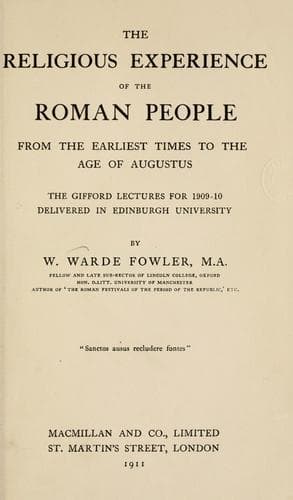
The Religious Experience of the Roman People: From the Earliest Times to the Age of AugustusFowler, W. Warde (William Warde)
Religion
The Religious Experience of the Roman People: From the Earliest Times to the Age of Augustus
Fowler, W. Warde (William Warde)
Cults -- Rome; Rome -- Religion
I go on to note one or two more examples of real magic in the State
religion; but they are hard to find. Pliny tells that even in his day
people believed that a runaway slave who had not escaped out of the city
might be arrested by a spell uttered by the Vestal virgins.[99] I take
this to mean that any one who had lost his slave might get the Vestals
to use the spell as a means of keeping the runaway within the city. The
word for spell is here _precatio_, _i.e._ a prayer, not _carmen_, which
is the usual word for a spell; and Pliny evidently thinks of it as
addressed to some god. But no doubt it was originally at least a genuine
spell, of the same kind as others used in private life, which we shall
notice directly; and it implies a belief in some magical power inherent
in the Vestals, of whom we are told that if they accidentally met a
criminal being led to punishment they might secure his release.[100] As
the spell in this case seems to be telepathic, _i.e._ an exercise of
will-power projected from a distance, it may perhaps be paralleled with
certain mystical powers exercised by women, especially when their
husbands are at war, among some savage peoples;[101] but we have no
information about it beyond the passage in Pliny, and further guessing
would be useless.
This last is a case of genuine magic, but it is outside the ritual of
the State, though exercised by a State priesthood. Within that ritual
there is one other very curious case of what must be classed as a
magical process, and one that has accidentally become famous. At the
Lupercalia on February 15, the two young men called Luperci, or, more
strictly, belonging respectively as leaders to the two collegia of
Luperci, girt themselves with the skins of the slaughtered victims,
which were goats, and then ran round the base of the Palatine hill,
striking at all the women who came near them or offered themselves to
their blows, with strips of skin cut from the hides of these same
victims. The object was to produce fertility; on this point our
authorities are explicit.[102] Thus this particular feature of the whole
extraordinary ritual of the Lupercalia is unmistakably within the region
of magic rather than of religion. Some potency was believed to work in
the act of striking, though apparently without a spoken spell or
_carmen_, such as usually accompanies acts of this kind; and this part
of the rite, grotesque though it was, was allowed to survive by the
grave religious authorities who drew up the calendar of religious
festivals. It was probably a superstition too deeply rooted in the minds
of the people to admit of being excluded; and, strange to say, it
survived, in outward form at least, until Rome had become cosmopolitan
and even Christian. The Lupercalia has always been a puzzle to students
of early religion, and as each new theory is advanced, this strange
festival is seized on for fresh interpretation;[103] but for our present
Public-domain text, read in full here on John Shaqi.
Reviews
Reviews
No reviews yet
Be the first to share your thoughts on this work.
Elsewhere in the archive
Join the Discussion
Join the discussion
Sign in to leave a comment or review.
Sign InorCreate an account