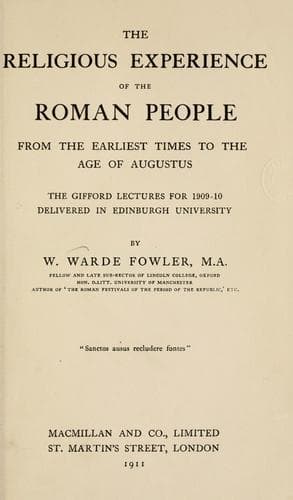
The Religious Experience of the Roman People: From the Earliest Times to the Age of AugustusFowler, W. Warde (William Warde)
Religion
The Religious Experience of the Roman People: From the Earliest Times to the Age of Augustus
Fowler, W. Warde (William Warde)
Cults -- Rome; Rome -- Religion
This rite of the Argei, then, was a case of genuine magic, and exercised
by a State priesthood, virgins to whom certain magical powers were
supposed to be attached; it was, I think, a popular performance, like
one or two others which are also outside the limit of the Fasti,[106]
and was embodied in a more complicated ceremonial long after that
calendar had been drawn up. In the ritual authorised by the State, with
public objects in view, _i.e._ for the benefit of society as a whole,
there is hardly a trace of anything that we can call genuine magic
apart from the examples I have just been explaining. There were, I need
not say, many survivals of magical processes of which the true magical
intent had long been lost--ancient magical deposits in a social stratum
of religion, which I shall notice in their proper place. This is not
peculiar to the religion of the Romans; it is a phenomenon to be found
in all religions, even in those of the most highly developed type, and
it is one apt to cause some confusion as to the true distinction between
magic and religion.[107] It is easy to find magical processes even in
Christian worship, if we have the will to do so; but if we steadily bear
in mind that the true test of magic is not the nature of an act, but the
intent or volition which accompanies it, the search will not be an easy
one.
The modern French school of sociologists, which now has to be reckoned
with in investigating the early history of religion, claims that magic
was not originally, as we now see it, a matter of individual skill, but
a sociological fact, _i.e._ it was used for the benefit of the
community, as religion came to be in a later age. If this be true, as it
very possibly is, we see at once how the dead bones of magical processes
might survive, with their original meaning entirely lost, into an age in
which higher and more reasonable ideas had been developed about the
relation of Man to the Power manifesting itself in the universe. To take
a single example from Rome, divination by the examination of a victim's
entrails was originally a magical process, according to the opinion of
most modern authorities;[108] but it ceases to be magic when it is used
simply to determine in the State ritual whether in a religious process
the victim is perfect and agreeable to the deity. In fact magical
formulae, magical instruments, unless they are used in the true spirit
of magic, to compel, not to propitiate a deity, are no longer magic, and
may be passed over here. When we come to discuss the ritual of sacrifice
and prayer, of _lustratio_, of vows, of divination, we may find it
necessary to recall what has here been said. On the whole, we may
conclude that organised religious cult, from its very nature and object,
everywhere excluded magic in the true sense of the word; it implies
prayer and propitiation, both of which are absolutely inconsistent with
the object and methods of magic. Religion is the product of a higher
Public-domain text, read in full here on John Shaqi.
Reviews
Reviews
No reviews yet
Be the first to share your thoughts on this work.
Elsewhere in the archive
Join the Discussion
Join the discussion
Sign in to leave a comment or review.
Sign InorCreate an account