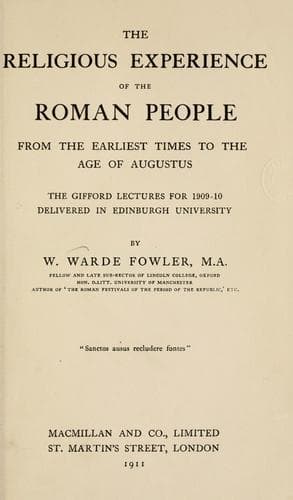
The Religious Experience of the Roman People: From the Earliest Times to the Age of AugustusFowler, W. Warde (William Warde)
Religion
The Religious Experience of the Roman People: From the Earliest Times to the Age of Augustus
Fowler, W. Warde (William Warde)
Cults -- Rome; Rome -- Religion
stage of social development; it is the expression of a real advance of
human thought; and in telling the story of the religious experience of
the Roman people we are but indirectly concerned with those more rude
and rudimentary ideas which it displaced.
But in private life, outside of the organised cult of the State and the
family, magic was all through Roman history abundant, even
over-abundant, and in this form I cannot pass it over entirely. Though
the State authorities seem to have taken pains to exclude it rigidly
from the public rites, and though there is little trace of it in the
religious life of family and gens, yet there is evidence that it was
deeply rooted in the nature of the people, and that they must have
passed through an age in which it was an important factor in their
social life. This fact, taken together with its almost complete
elimination from the public religion, throws into relief the persistent
efforts of the State authorities, from the framing of the old religious
calendar to the time of the Augustan revival, to keep their relations
with the Power clear of all that they believed to be unworthy or
injurious. No better example can be found of the inherent antagonism
between religion and magic.
Private magic may be divided into two kinds, according as it was used to
damage another, or only to benefit oneself. In the former case the State
interfered to protect the person threatened with damage, and treated
this kind of magic as a crime. The commonest form of it was that of the
spell, or _carmen_, no doubt often sung, and accompanied by some action
which would bring it under the head of sympathetic magic; but the spell
alone is taken cognisance of by the State. Pliny has preserved three
words from the XII. Tables which tell their own tale: "qui fruges
excantassit."[109] Servius, commenting on the line of Virgil's 8th
_Eclogue_, "atque satas alio vidi traducere messes," writes, "magicis
quibusdam artibus hoc fiebat, unde est in XII. Tabb. 'Neve alienam
segetem pellexeris.'" These last words, with the verb in the second
person, are probably not quoted exactly from the ancient text,[110] but
they help to show us the nature of this hostile spell. There must have
been a belief that the spirit, or life, or fructifying power of your
neighbour's crops could be enticed away and transferred to your own.
This is confirmed by a remark of St. Augustine in the _de Civitate
Dei_;[111] after quoting the same line from Virgil, he adds, "eo quod
hac pestifera scelerataque doctrina fructus alieni in alias terras
transferri perhibentur, nonne in XII. Tabulis, id est Romanorum
antiquissimis legibus, Cicero commemorat esse conscriptum et ei qui hoc
fecerit supplicium constitutum?" Given the belief, the temptation can be
well understood if we reflect that the arable land of the old Romans was
divided in sections of a square, and that each man's allotment would
have that of a neighbour on two sides at least.[112] If one man's corn
Public-domain text, read in full here on John Shaqi.
Reviews
Reviews
No reviews yet
Be the first to share your thoughts on this work.
Elsewhere in the archive
Join the Discussion
Join the discussion
Sign in to leave a comment or review.
Sign InorCreate an account