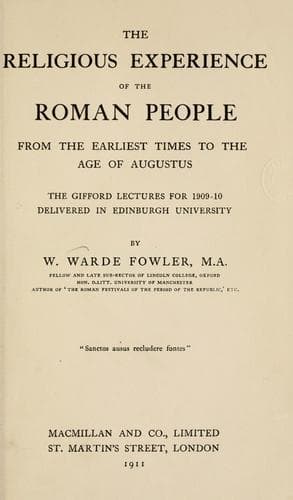
The Religious Experience of the Roman People: From the Earliest Times to the Age of AugustusFowler, W. Warde (William Warde)
Religion
The Religious Experience of the Roman People: From the Earliest Times to the Age of Augustus
Fowler, W. Warde (William Warde)
Cults -- Rome; Rome -- Religion
were found to be more flourishing than that of his neighbours, what more
likely than that he should have enticed away the spirit of their crops?
The process reminds us, as it reminded Pliny, of the _evocatio_ of the
gods of foreign communities, a rite which belongs to religion and not to
magic, though it doubtless had its origin in the same class of ideas as
the _excantatio_.
In more general terms the old Roman law (_i.e._ originally the _ius
divinum_) forbade the use of evil spells, as we see in another fragment
of the Tables, "qui malum carmen incantassit." In later times this was
usually taken as referring to libel and slander, but there can be no
doubt that the carmina here alluded to were originally magical, and
became _carmina famosa_ in the course of legal interpretation. Cicero
seems to combine the two meanings in the _de Rep._ (iv. 10. 2) when he
says that the Tables made it a capital offence "si quis occentavisset,
sive carmen condidisset quod infamiam faceret flagitiumve alteri" (to
bring shame or criminal reproach on another). In the later sense these
carmina have a curious history, into which I cannot enter now.[113] In
the earlier sense they existed and flourished without doubt, in spite of
the law; or it may be that, as the words of the Tables were interpreted
in the new sense, the old form of offence was tolerated in private. "We
are all afraid," says Pliny, "of being 'nailed' (_defigi_) by spells and
curses" (_diris precationibus_).[114] These _dirae_, and all the various
forms of love-charms, _defixiones_, accompanied by the symbolic actions
which are found all the world over, lie outside my present subject, and
are so familiar to us all in Roman literature that I do not need to
dwell on them.[115]
Nor of the common harmless kind of magic need I say much now. It
survived, of course, alongside of the religion of the family and State,
from the earliest times to the latest, as it survives at the present day
in all countries civilised and uncivilised; and being harmless the State
took no heed of it. Some assortment of charms and spells for the cure of
diseases will be found in Cato's book on agriculture, and one or two
incidentally occur in that of Varro.[116] They performed the work of
insurance against both fire and accident, and even such a man as Julius
Caesar was not independent of such arts. Pliny tells us that after
experiencing a carriage accident he used to repeat a certain spell three
times as soon as he had taken his seat in a vehicle, and adds
significantly, "id quod plerosque nunc facere scimus."[117] Such carmina
were written on the walls of houses to insure them against fire.[118]
Pliny has a large collection of small magical delusions and
superstitions, many of which have an interest for anthropologists, in
the 28th book of his _Natural History_.
Public-domain text, read in full here on John Shaqi.
Reviews
Reviews
No reviews yet
Be the first to share your thoughts on this work.
Elsewhere in the archive
Join the Discussion
Join the discussion
Sign in to leave a comment or review.
Sign InorCreate an account