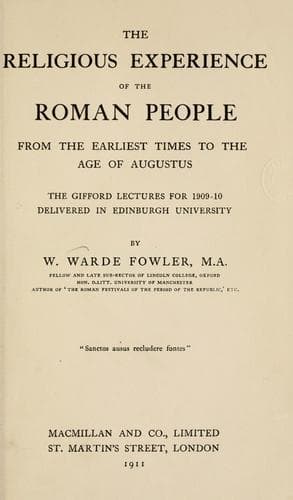
The Religious Experience of the Roman People: From the Earliest Times to the Age of AugustusFowler, W. Warde (William Warde)
Religion
The Religious Experience of the Roman People: From the Earliest Times to the Age of Augustus
Fowler, W. Warde (William Warde)
Cults -- Rome; Rome -- Religion
So much, then, for magical charms and spells, and the survivals of them
in the fully developed Roman religion.[130] It might seem hardly worth
while to spend even so much time on them as I have done, and I cannot
deny that I am glad now to be able to leave them. My object has simply
been to show how little of this kind of practice, which meets us on the
threshold of religion, was allowed to survive by the religious
authorities of the State; in other words, I wished to make clear that in
our inquiries into the nature of the Roman religion it is really
religion and not magic that we have to do with.
It is really religion; it is desire, beginning already to be effective,
to be in right relation to the Power manifesting itself in the universe.
The Romans, as I hope to show in the next lecture, when we can begin to
know and feel an interest in them, had not only begun to recognise this
Power in various forms and functions as one that must be propitiated,
because they were dependent on it for their daily needs, but to regulate
and make permanent the methods of propitiation. What was the relation
between this simple religion and morality--between ritual and
conduct--is a very difficult question, to which I shall return later on.
Dr. Westermarck has recently come to the conclusion that the religion of
primitive man has no true relation to morality, that it is not apt to
give a sanction to good action, or to develop the germs of a conscience.
But so far as I can discern, the idea of active duty, and therefore the
germ of conscience, must have been so intimately connected with the
religious practice of the old Latin family that it is to me impossible
to think of the one apart from the other. Surely it is in that life that
the famous word "_pius_" must have originated, which throughout Roman
history meant the sense of duty towards family, State, and gods, as
every reader of the _Aeneid_ knows. That the formalised religion of
later times had become almost entirely divorced from morality there is
indeed no doubt; but in the earliest times, in the old Roman family and
then in the budding State, the whole life of the Roman seems to me so
inextricably bound up with his religion that I cannot possibly see how
that religion can have been distinguishable from his simple idea of duty
and discipline.
NOTES TO LECTURE III
[81] Westermarck, _Origin etc. of Moral Ideas_, ii. 584.
[82] Jevons, _Introduction_, p. 33.
[83] A useful summary of the whole subject, embodying
the results and terminology of Tylor, Frazer, and other
anthropologists, is Dr. Haddon's _Magic and Fetishism_,
in Messrs. Constable's series, _Religions Ancient and
Modern_. See also Marett, _On the Threshold of
Religion_, passim.
Public-domain text, read in full here on John Shaqi.
Reviews
Reviews
No reviews yet
Be the first to share your thoughts on this work.
Elsewhere in the archive
Join the Discussion
Join the discussion
Sign in to leave a comment or review.
Sign InorCreate an account