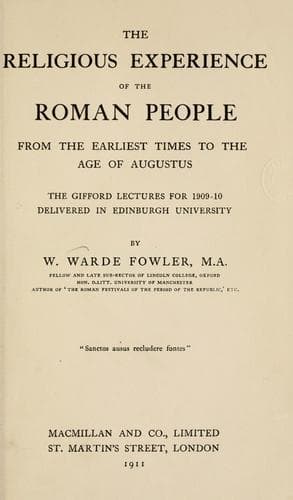
The Religious Experience of the Roman People: From the Earliest Times to the Age of AugustusFowler, W. Warde (William Warde)
Religion
The Religious Experience of the Roman People: From the Earliest Times to the Age of Augustus
Fowler, W. Warde (William Warde)
Cults -- Rome; Rome -- Religion
[84] _Lectures on the Early History of the Kingship_, p.
89 foll. For an example not mentioned in the text
(_devotio_) see below, p. 206 foll. This may have been
originally practised by the Latin kings. I may here
draw attention to the almost dogmatic conclusions of the
modern French sociological school of research; _e.g._ M.
Huvelin, in _L'Annee sociologique_ for 1907, begins by
asserting as a fundamental law, proved by MM. Hubert et
Mauss, that magic is just as much a social fact as
religion: "Les uns et les autres sont des produits de
l'activite collective" (_Magie et droit individuel_, p.
1). But M. Huvelin's paper is to some extent a
modification of this dogma. He seeks to explain the fact
that magic is both secret and private, not public and
social, in historical times; and in the domain of law,
with which he is specially concerned, he concludes that
"a magical rite is only a religious rite twisted from
its proper social end, and employed to realise the will
or belief of an individual" (p. 46). This is the only
form in which we shall find magic at Rome, except in so
far as a few of its forms survive in the ritual of
religion with their meaning changed. In early Roman law,
as a quasi-religious body of rules and practices, there
are a few magical survivals which will be found
mentioned by M. Huvelin in this article; but they are of
no importance for our present subject.
[85] _Primitive Culture_, vol. i. ch. iv. See also
Jevons, _Introduction_, p. 36 foll.
[86] See Schuerer, _Jewish People in the Time of Christ_
(Eng. trans.), Division II. vol. iii. p. 151 foll.
[87] Fowler, _R.F._ p. 232; Wissowa, _R.K._ p. 106. The
most careful examination of the rite and the evidence
for it is that of Aust in _Mythological Lexicon_, _s.v._
"Iuppiter," p. 656 foll. See also M.H. Morgan in vol.
xxxii. of _Transactions of the American Philological
Association_, p. 104.
[88] Tertullian, _de Jejun_. 16. Petronius, _Sat._ 44,
adds that the matrons went in the procession with bare
feet and streaming hair (cp. Pliny xvii. 266); but this
seems rather Greek than Roman in character, and
Petronius is plainly thinking of the town (_colonia_ he
calls it) in southern Italy where the scene of
Trimalchio's supper is laid; probably a Greek city by
origin, Croton or Cumae. A translation of this passage
will be found in Dill's _Roman Society from Nero to
Marcus Aurelius_, p. 133. The most useful words in it
for our purpose are "Jovem aquam exorabant."
[89] This suggestion was originally made by O. Gilbert,
_Roem. Topographie_, ii. 184.
[90] p. 204 foll.
[91] p. 657. The story is mixed up with Greek fables,
_e.g._ that of Proteus, as Wissowa has pointed out,
_R.K._ p. 106, note 10.
Public-domain text, read in full here on John Shaqi.
Reviews
Reviews
No reviews yet
Be the first to share your thoughts on this work.
Elsewhere in the archive
Join the Discussion
Join the discussion
Sign in to leave a comment or review.
Sign InorCreate an account