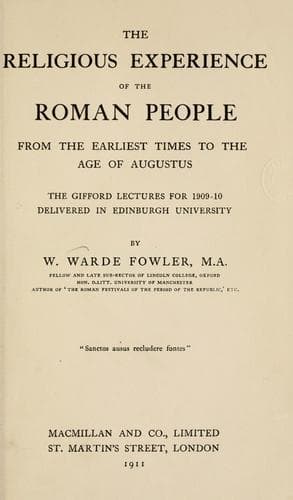
The Religious Experience of the Roman People: From the Earliest Times to the Age of AugustusFowler, W. Warde (William Warde)
Religion
The Religious Experience of the Roman People: From the Earliest Times to the Age of Augustus
Fowler, W. Warde (William Warde)
Cults -- Rome; Rome -- Religion
[115] The most familiar examples are Virgil's eighth
_Eclogue_, 95 foll.; Ovid, _Met._ vii. 167, and
elsewhere; _Fasti_, iv. 551; Horace, _Epode_ v. 72; cp.
article "Magia" in Daremberg-Saglio; Falz, _De poet.
Rom. doctrina magica_, Giessen, 1903. There is a
collection of Roman magical spells in Appel's _De
Romanorum precationibus_, p. 43 foll. Many modern
Italian examples and survivals will be found in Leland's
_Etruscan Roman Remains in Popular Tradition_, pt. ii.
[116] Cato, _R.R._ 160; Varro, _R.R._ i. 3.
[117] Pliny, _N.H._ xxviii. 21.
[118] _Ib._ xxviii. 20. The following sections of this
book are the _locus classicus_ for these popular
superstitions.
[119] See, _e.g._, _Italian Home Life_, by Lina Duff
Gordon, p. 230 foll.
[120] Juvenal v. 164. The idea probably arose, as a
passage of Plutarch suggests (_Rom._ 25), from the fact
that the triumphator, whose garb was no doubt of
Etruscan origin, wore the bulla.
[121] Frazer, _G.B._ i. 345, note 2, where we learn that
gold was taboo in some Greek worships, _e.g._ at the
mysteries of Andania, which sufficiently proves that it
possessed potency. Pliny, xxxiii. 84, mentions cases of
such potency as medicine, and among them its application
to children who have been poisoned.
[122] Pliny, _N.H._ xxviii. 39.
[123] See an article by the author on the original
meaning of the _toga praetexta_ in _Classical Review_,
vol. x. (1896) p. 317.
[124] For the Compitalia, Macrob. i. 7. 34; Festus p.
238. For the Paganalia, Probus, _ad Georg._ ii. 385,
assuming the _feriae Sementinae_ there mentioned to be
the Paganalia (see _R.F._ p. 294). For the _feriae
Latinae_, Festus, _s.v._ "oscillantes."
[125] Wissowa, _R.K._ p. 193, with whose view I entirely
agree. We learn of the imaginary goddess from Varro,
_L.L._ ix. 61. Pais, I may remark in passing, is certain
that Acca Larentia was the mater Larum; see his
_Lectures on Ancient Legends of Roman History_, p. 60
foll.
[126] 46. Wissowa, _R.K._ p. 354, note 5.
[127] _Georg._ ii. 380 foll. It is not certain that
Virgil is describing the festival generally known as
Paganalia, which took place early in January; but it
seems probable from line 382 that he is thinking of some
festival of the pagus. The _oscilla_ may have been used
at more than one.
Public-domain text, read in full here on John Shaqi.
Reviews
Reviews
No reviews yet
Be the first to share your thoughts on this work.
Elsewhere in the archive
Join the Discussion
Join the discussion
Sign in to leave a comment or review.
Sign InorCreate an account