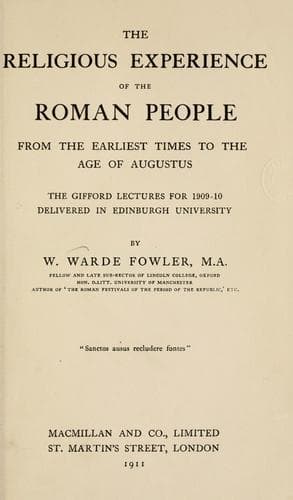
The Religious Experience of the Roman People: From the Earliest Times to the Age of AugustusFowler, W. Warde (William Warde)
Religion
The Religious Experience of the Roman People: From the Earliest Times to the Age of Augustus
Fowler, W. Warde (William Warde)
Cults -- Rome; Rome -- Religion
[107] Thus Messrs. Hubert et Mauss (_Melanges d'histoire
des religions_, Preface, p. xxiv.) maintain that there
is no real antinomy between "les faits du systeme
magique et les faits du systeme religieux." There is in
every rite, they insist, a magical as well as a
religious element. Yet on the same page we find that
they exclude magic from all organised cult, because it
is not obligatory, and cannot (if I understand them
rightly) be laid down in a code, like religious
practice. I think it would have been simpler to consider
the magical element in religious rites as surviving,
with its original meaning lost, from an earlier stage of
thought. M. van Gennep, in his interesting work _Les
Rites de passage_, p. 17, goes so far as to call all
religious _ceremonies_ magical, as distinguished from
the _theories_ (_e.g._ animism) which constitute
religion. This seems to me apt to bring confusion into
the discussion; for all rites are the outward expression
of thought, and it is by the thought (or, as he calls
it, theories) that we must trace the sociological
development of mankind, the rites being used as indexes
only. I cannot but think that (as indeed in these days
is quite natural) this French school lays too much
stress upon the outward acts, and that this tendency has
led them to find real living magic where it is present
only in a fossil state.
[108] _e.g._ Tylor, article "Magic" in _Encycl. Brit._,
and _Primitive Culture_, 1. ch. iv.; Marett, _Threshold
of Religion_, 83. See below, p. 180.
[109] Pliny, _N.H._ xxviii. 17 and 18. For the singing
or murmuring of spells in many countries, see Jevons,
_Anthropology and the Classics_, p. 93 foll.
[110] Bruns, _Fontes Iuris Romani_, note on this
passage.
[111] _Civ. Dei_, viii. 19.
[112] See, _e.g._, Wordsworth, _Fragments and Specimens
of Early Latin_, p. 446, for an account of simple land
measurement which will suffice to illustrate the point
made here.
[113] The _carmina famosa_ sung at a triumph by the
soldiers had the same origin, but were used to avert
evil from the triumphator. The best exposition of this
is in H. A. J. Munro's _Elucidations of Catullus_, p. 76
foll.
[114] Pliny, _N.H._ xxviii. 19. For the technical sense
of _defigere_, _defixio_, see Jevons in _Anthropology
and the Classics_, p. 108 foll.
Public-domain text, read in full here on John Shaqi.
Reviews
Reviews
No reviews yet
Be the first to share your thoughts on this work.
Elsewhere in the archive
Join the Discussion
Join the discussion
Sign in to leave a comment or review.
Sign InorCreate an account