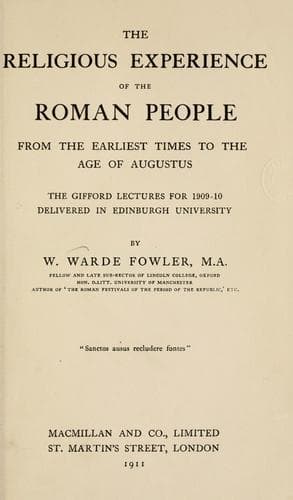
The Religious Experience of the Roman People: From the Earliest Times to the Age of Augustus — John Shaqi
The Religious Experience of the Roman People: From the Earliest Times to the Age of AugustusFowler, W. Warde (William Warde)
Religion
The Religious Experience of the Roman People: From the Earliest Times to the Age of Augustus
Fowler, W. Warde (William Warde)
Cults -- Rome; Rome -- Religion
Religious destitution of the Roman in second century
B.C. in regard to (1) his idea of God, (2) his sense of
Duty. No help from Epicurism, which provided no
religious sanction for conduct; Lucretius, and Epicurean
idea of the Divine. Arrival of Stoicism at Rome;
Panaetius and the Scipionic circle. Character of Scipio.
The religious side of Stoicism; it teaches a new
doctrine of the relation of man to God. Stoic idea of
God as Reason, and as pervading the universe; adjustment
of this to Roman idea of _numina_. Stoic idea of Man as
possessing Reason, and so partaking the Divine nature.
Influence of these two ideas on the best type of Roman;
they appeal to his idea of Duty, and ennoble his idea of
Law. Weak points in Roman Stoicism: (1) doctrine of
Will, (2) neglect of emotions and sympathy. It failed to
rouse an "enthusiasm of humanity" 357-379
LECTURE XVII
MYSTICISM--IDEAS OF A FUTURE LIFE
Early Pythagoreanism in S. Italy; its reappearance in
last century B.C. under the influence of Posidonius, who
combined Stoicism with Platonic Pythagoreanism. Cicero
affected by this revival; his Somnium Scipionis and
other later works. His mysticism takes practical form on
the death of his daughter; letters to Atticus about a
_fanum_. Individualisation of the Manes; freedom of
belief on such questions. Further evidence of Cicero's
tendency to mysticism at this time (45 B.C.), and his
belief in a future life. But did the ordinary Roman so
believe? Question whether he really believed in the
torments of Hades. Probability of this: explanation to
be found in the influence of Etruscan art and Greek
plays on primitive Roman ideas of the dead. Mysticism in
the form of astrology; Nigidius Figulus 380-402
LECTURE XVIII
RELIGIOUS FEELING IN THE POEMS OF VIRGIL
Virgil sums up Roman religious experience, and combines
it with hope for the future. Sense of depression in his
day; want of sympathy and goodwill towards men. Virgil's
sympathetic outlook; shown in his treatment of animals,
Italian scenery, man's labour, and man's worship. His
idea of _pietas_. The theme of the Aeneid; Rome's
mission in the world, and the _pietas_ needed to carry
it out. Development of the character of Aeneas; his
_pietas_ imperfect in the first six books, perfected in
the last six, resulting in a balance between the ideas
of the Individual and the State. Illustration of this
from the poem. Importance of Book vi., which describes
the ordeal destined to perfect the _pietas_ of the hero.
The sense of Duty never afterwards deserts him; his
_pietas_ enlarged in a religious sense 403-427
LECTURE XIX
THE AUGUSTAN REVIVAL
Public-domain text, read in full here on John Shaqi.
Reviews
Reviews
No reviews yet
Be the first to share your thoughts on this work.
Join the Discussion
Join the discussion
Sign in to leave a comment or review.
Sign InorCreate an account