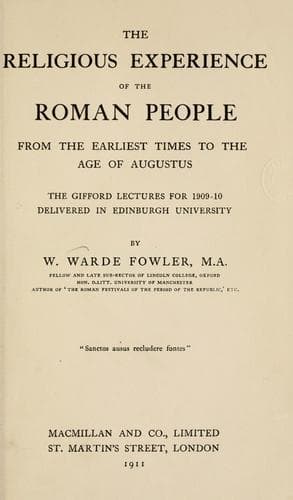
The Religious Experience of the Roman People: From the Earliest Times to the Age of AugustusFowler, W. Warde (William Warde)
Religion
The Religious Experience of the Roman People: From the Earliest Times to the Age of Augustus
Fowler, W. Warde (William Warde)
Cults -- Rome; Rome -- Religion
I would suggest that we
may see in it the connecting link between that group and the individual
adult males within it; in that case the Genius would be that soul of a
man which enables him to fulfil the work of continuing the life of the
gens. We can easily imagine how it might eventually come to be his
guardian spirit, and to acquire all the other senses with which we are
familiar in Roman literature. With the development of the idea of
individuality, the individuality of a man as apart from the kin group,
the idea of the individuality of the Genius also became emphasised,
until it became possible to think of it as even living on after the
death of its companion;[152] in this way, in course of time, the Genius
came to exercise a curious influence on the idea of the Manes. The
history of the idea of Genius, and its application to places, cities,
etc., is indeed a curious one, and of no small interest in the study of
religion; but we must return to the primitive house and its divine
inhabitants. There is one more of these who calls for a word before I
pass to the land and the boundaries; we meet him on the threshold as we
leave the dwelling.
It is, of course, well known to anthropologists that the door of a house
is a dangerous point, because evil spirits or the ghosts of the dead may
gain access to the house through it. Among the innumerable customs which
attest this belief there are one or two Roman ones, _e.g._ the practice
of making a man, who has returned home after his supposed death in a
foreign country, enter the house by the roof instead of the door; for
the door must be kept barred against ghosts, and this man may be after
all a ghost, or at least he may have evil spirits or miasma about
him.[153] It was at the doorway that a curious ceremony took place (to
which I shall ask your attention again) immediately after the birth of a
child, in order to prevent Silvanus, who may stand for the dangerous
spirits of the forest, from entering in and vexing the baby.[154] Again,
a dead man, as among so many other peoples, was carried out of the
doorway with his feet foremost, so that he should not find his way back;
and the old Roman practice of burial by night probably had the same
object.[155] Exactly the same anxiety (_religio_) is seen in regard to
the gates of a city; the wall was in some sense holy (_sanctus_), but
the gates, through which was destined to pass much that might be
dangerous, could not be thus sanctified. Was there, then, no protecting
spirit of these doors and gates?
Public-domain text, read in full here on John Shaqi.
Reviews
Reviews
No reviews yet
Be the first to share your thoughts on this work.
Elsewhere in the archive
Join the Discussion
Join the discussion
Sign in to leave a comment or review.
Sign InorCreate an account