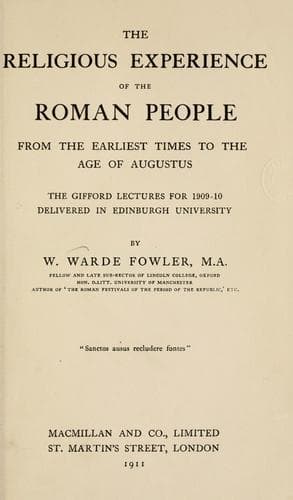
The Religious Experience of the Roman People: From the Earliest Times to the Age of AugustusFowler, W. Warde (William Warde)
Religion
The Religious Experience of the Roman People: From the Earliest Times to the Age of Augustus
Fowler, W. Warde (William Warde)
Cults -- Rome; Rome -- Religion
St. Augustine, writing with Varro before him, finds no less than three
spirits of the entrance to a house: Forculus, of the door itself;
Limentinus, of the threshold; and Cardea, of the hinges of the door; and
these Varro seems to have found in the books of the pontifices.[156] I
must postpone the question as to what these pontifical books really
represented; but the passage will at least serve to show us the popular
anxiety about the point of entrance to a house, and its association with
the spirit world. Of late sober research has reached the conclusion that
the original door-spirit was Janus, whom we know in Roman history as
residing in the symbolic gate of the Forum, and as the god of
beginnings, the first deity to be invoked in prayer, as Vesta was the
last.[157] But Janus is also wanted for far higher purposes by some
eminent Cambridge scholars; they have their own reasons for wanting him
as a god of the sky, as a double of Jupiter, as the mate of Diana, and a
deity of the oak.[158] So, too, he was wanted by the philosophical
speculators of the last century B.C., who tried to interpret their own
humble deities in terms of Greek philosophy and Greek polytheism. The
poets too, who, as Augustine says, found Forculus and his companions
beneath their notice, played strange tricks with this hoary old god, as
any one may read in the first book of Ovid's _Fasti_. I myself believe
that the main features of the theology (if we may use the word) of the
earliest Rome were derived from the house and the land as an economic
and religious unit, and I am strongly inclined to see in Janus bifrons
of the Forum a developed form of the spirit of the house-door; but the
question is a difficult one, and I shall return to it in a lecture on
the deities of early Rome.
Public-domain text, read in full here on John Shaqi.
Reviews
Reviews
No reviews yet
Be the first to share your thoughts on this work.
Elsewhere in the archive
Join the Discussion
Join the discussion
Sign in to leave a comment or review.
Sign InorCreate an account