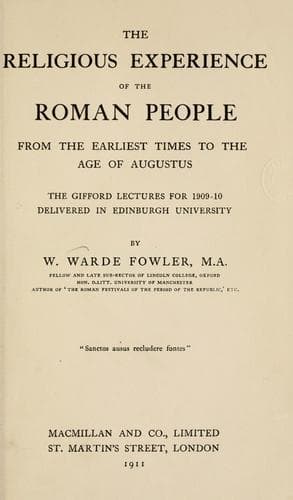
The Religious Experience of the Roman People: From the Earliest Times to the Age of AugustusFowler, W. Warde (William Warde)
Religion
The Religious Experience of the Roman People: From the Earliest Times to the Age of Augustus
Fowler, W. Warde (William Warde)
Cults -- Rome; Rome -- Religion
Lastly, the death of a member of the family was an occasion of extreme
anxiety, which might, however, be allayed by the exact performance of
certain rites (_iusta facere_). The funeral ceremonies of the City-state
were of a complicated character, and the details are not all of them
easy to interpret. But the principle must have been always the
same--that the dead would "walk" unless they had been deposited with due
ceremony in the bosom of Mother Earth, and that their natural tendency
in "walking" was to find their way back to the house which had been
their home in life. Whether buried or burnt, the idea was the same: if
burnt, as seems to have been common Roman practice from very early
times, at least one bone had to be buried as representing the whole
body. We have seen that certain precautions were taken to prevent the
dead man from finding his way back, such as carrying him out of the
house feet foremost; and if he were properly buried and the house duly
purified afterwards, the process of prevention was fairly complete. His
ghost, shade, or double then passed beneath the earth to join the whole
body of Manes in the underworld,[182] and could only return at certain
fixed times--such at least was the idea expressed in the customs of
later ages. But if a paterfamilias or his representative had omitted
_iusta facere_, or if the dead man had never been buried at all, carried
off by an enemy or some wild beast, he could never have descended to
that underworld, and was roaming the earth disconsolately, and with an
evil will. The primitive idea of anxiety is well expressed in the Roman
festival of the Lemuria in May, when the head of a household could get
rid of the ghosts by spitting out black beans[183] from his mouth and
saying, "With these I redeem me and mine." Nine times he says this
without looking round: then come the ghosts behind him and gather up the
beans unseen. After other quaint performances he nine times repeats the
formula, "Manes exite paterni," then at last looks round, and the ghosts
are gone.[184] This is plainly a survival from the private life of the
primitive household, and well illustrates its fears and anxieties; but
the State provided, as we shall see, another and more religious
ceremony, put limitations on the mischievous freedom of the ghosts, and
ordained the means of expiation for those who had made a slip in the
funeral ceremonies, or whose dead had been buried at sea or had died in
a far country.
Public-domain text, read in full here on John Shaqi.
Reviews
Reviews
No reviews yet
Be the first to share your thoughts on this work.
Elsewhere in the archive
Join the Discussion
Join the discussion
Sign in to leave a comment or review.
Sign InorCreate an account