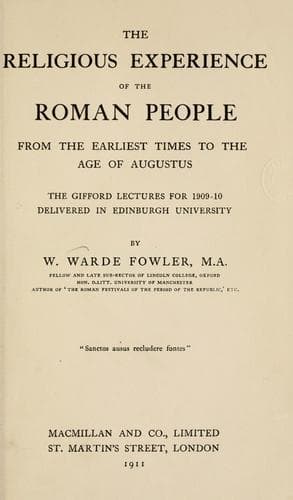
The Religious Experience of the Roman People: From the Earliest Times to the Age of AugustusFowler, W. Warde (William Warde)
Religion
The Religious Experience of the Roman People: From the Earliest Times to the Age of Augustus
Fowler, W. Warde (William Warde)
Cults -- Rome; Rome -- Religion
I have thus tried to sketch the life of the early Latin family in its
relations with the various manifestations of the Power in the universe.
We have seen enough, I think, to conclude that it had a strong desire to
be in right relations with that Power, and to understand its will; but
we may doubt whether that desire had as yet become very effective. The
circumstances of the life of the Latin farmer were hardly such as to rid
him of much of the _religio_ that he had inherited from his wilder
ancestors, or had found springing up afresh within him as he contended
with the soil, the elements, and the hostile beings surrounding him,
animal, human, and spiritual. He is living in an age of transition; he
is half-way between the age of magic and a new age of religion and duty.
NOTES TO LECTURE IV
[131] Frazer, _Lectures on the Early History of the
Kingship_, lect. viii. Dr. Frazer finds traces of
Mutterrecht only in the succession to the kingship of
Alba and Rome, of which the evidence is of course purely
legendary. If the legends represent fact in any sense,
they point, if I understand him rightly, to a kingship
held by a non-Latin race, or, as he calls it, plebeian.
Binder, _Die Plebs_, p. 403 foll., believes that the
original Latin population, _i.e._ the plebs of later
times, lived under Mutterrecht.
[132] Aust, _Religion der Roemer_, p. 212.
[133] In historical times the household deities were
often represented by images of Greek type: _e.g._ the
Penates by those of the Dioscuri. Wissowa, _Rel. und
Kult._ p. 147, and _Gesammelte Abhandlungen_, p. 95
foll., and 289. See also De Marchi, _La Religione nella
vita privata_, i. p. 41 foll. and p. 90 foll.
[134] De Marchi, _op. cit._ i. 13 foll. In the ordinary
and regular religion of the family the State, _i.e._ the
pontifices, did not interfere; but they might do so in
matters such as the succession of _sacra_, the care of
graves, or the fulfilment of vows undertaken by private
persons. See Cicero, _de Legibus_, ii. 19. 47.
[135] Mucius Scaevola, the great lawyer, defined
_gentiles_ as those "qui eodem nomine sunt, qui ab
ingenuis oriundi sunt, quorum maiorum nemo servitutem
servivit, qui capite non sunt deminuti," Cic. _Topica_,
vi. 29. This is the practical view of a lawyer of the
last century B.C., and does not take account of the
_sacra gentilicia_, which had by that time decayed or
passed into the care of _sodalitates_: Marquardt, p. 132
foll.; De Marchi, ii. p. 3 foll. The notion of descent
from a common ancestor is of course ideal, but none the
less a factor in the life of the gens; it crops up,
_e.g._, in Virgil, _Aen._ v. 117, 121, and Servius _ad
loc._
[136] Crawley, _The Tree of Life_, p. 47.
[137] For the alleged extinction of the gens Potitia,
and the legend connected with it, Livy i. 7, Festus 237.
Public-domain text, read in full here on John Shaqi.
Reviews
Reviews
No reviews yet
Be the first to share your thoughts on this work.
Elsewhere in the archive
Join the Discussion
Join the discussion
Sign in to leave a comment or review.
Sign InorCreate an account