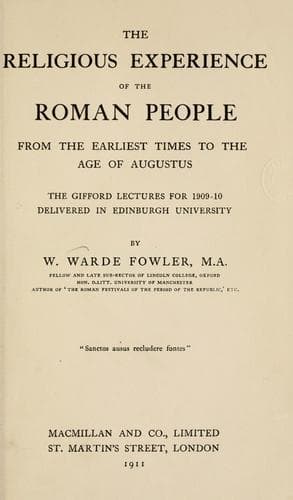
The Religious Experience of the Roman People: From the Earliest Times to the Age of AugustusFowler, W. Warde (William Warde)
Religion
The Religious Experience of the Roman People: From the Earliest Times to the Age of Augustus
Fowler, W. Warde (William Warde)
Cults -- Rome; Rome -- Religion
The religion of the household had two main characteristics. First, it
was a perfectly natural and organic growth, the result of the Roman
farmer's effective desire to put himself and his in right relations with
the spiritual powers at work for good or ill around him. His conception
of these powers I shall deal with more fully in the next lecture; but I
have said enough to prove that it was not a degrading one. The spirits
of his house and his land and his own Genius were friendly powers, all
of them of the greatest importance for his life and his work, and their
claims were attended to with regularity and devotion. From Vesta and the
Penates, the Lar, the Genius, the Manes, and the spirits of the doorway
and the spring, there was nothing to fear if they were carefully
propitiated; and as his daily life and comfort depended on this
propitiation, they were really divine members of the _familia_, and
might become, and perhaps did become, the objects of real affection as
well as worship. In this well-regulated practical life of the early
agricultural settlers, with its careful attention to the claims of its
divine protectors, we may perhaps see the germs of a real religious
expression of human life.
Secondly, there was doubtless at the same time constant cause for
anxiety. Beyond the house and the land there were unreclaimed spirits of
the woodland which might force an entrance into the sacred limits of the
house; the ghosts of the dead members were constantly wishing to
return; the crops might be attacked by strange diseases, by storms or
drought, and man himself was liable to seasonal disease or sudden
pestilence. The cattle and sheep might stray into the remote forest and
become the prey of evil beasts, if not of evil spirits. How was the
farmer to meet all these troubles, caused, as he supposed, by spirits
whose ways he did not understand? How were they to be propitiated as
they themselves would wish? How were the omens to be interpreted from
which their will might be guessed? How were the proper times and seasons
for each religious operation to be discovered? If my imagination is not
at fault, I seem to see that the Latin farmer must have had to shift for
himself in most of his dealings with the supernatural powers about him;
_religio_, the sense of awe and of dependence, must have been constantly
with him. But even here we may see, I think, a possible germ of
religious development; for without this feeling of awe religious forms
tend to become meaningless: lull _religio_ to sleep, and the forms cease
to represent effectively man's experience of life. We have to see later
on how this paralysis of the religious instinct did actually take place
in early Roman history.
Public-domain text, read in full here on John Shaqi.
Reviews
Reviews
No reviews yet
Be the first to share your thoughts on this work.
Elsewhere in the archive
Join the Discussion
Join the discussion
Sign in to leave a comment or review.
Sign InorCreate an account