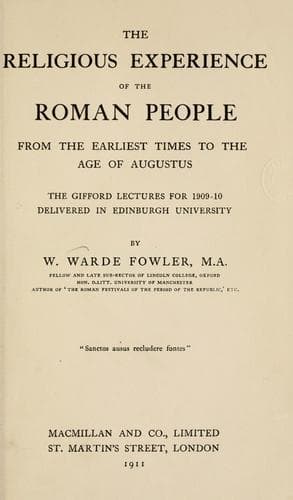
The Religious Experience of the Roman People: From the Earliest Times to the Age of AugustusFowler, W. Warde (William Warde)
Religion
The Religious Experience of the Roman People: From the Earliest Times to the Age of Augustus
Fowler, W. Warde (William Warde)
Cults -- Rome; Rome -- Religion
For we now have to leave the religion of the household, and to study
that of the earliest form of the City-state. We have enjoyed a glint of
light reflected from later times on the religion of the early Roman
family, and are about to enjoy another glint--nay, a gleam of real
light, and not merely a reflected one--which the earliest religious
document we possess casts on the religion of the City-state of Rome.
Between the two there is a long period of almost complete darkness. We
know hardly anything as yet, and it is not likely that we shall ever
know anything definite, about the stages of development which must have
been passed before Rome became the so-called city of the Four Regions,
when her history may be said really to begin. The pagus hardly helps us
here; it was not an essential advance on the family, and its religion
was comprehensive, not intensive. Each pagus, however, seems to have
had within its bounds an _oppidum_, or stronghold on a hill; and such
oppida were the seven _montes_ of early Rome, which, with the pagi
belonging to them, survived in name to the end of the Republic, with
some kind of a religious festival uniting them together, about which we
have hardly any knowledge.[185] This looks like a stage in the process
of change from farm to city, and it has generally been believed to mark
one. Unfortunately nothing to our purpose can be founded on it. We must
be content with the undoubted fact that about the eighth or seventh
century B.C. the site of Rome was occupied and strengthened as a bulwark
against the Etruscan people who were pressing down from the north upon
the valley of the Tiber;[186] we may take it that the old central
fortress of Latium, on the Alban hill, was not in the right position for
defence, and that it was seen to be absolutely necessary to make a
stronghold of the position offered by the hills which abut on the river
twenty miles above its mouth--the only real position of defence for the
Latin settlements in its rear. Here an _urbs_ was made with _murus_ and
_pomoerium_, _i.e._ material and spiritual boundaries, taking in a space
sufficient to hold the threatened rural population with their flocks and
herds, with the river in the front and a common citadel on the
Capitoline hill, and including the Palatine, Quirinal, Esquiline,
Caelian and Aventine hills, though the last named remained technically
outside the pomoerium.[187]
Public-domain text, read in full here on John Shaqi.
Reviews
Reviews
No reviews yet
Be the first to share your thoughts on this work.
Elsewhere in the archive
Join the Discussion
Join the discussion
Sign in to leave a comment or review.
Sign InorCreate an account