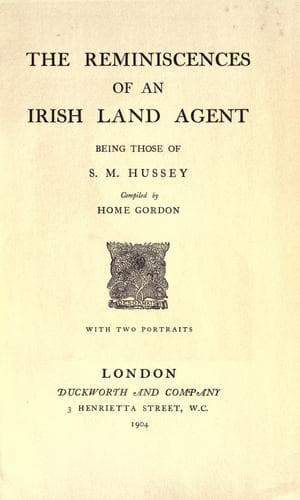
The Reminiscences of an Irish Land AgentHussey, Samuel Murray
History
The Reminiscences of an Irish Land Agent
Hussey, Samuel Murray
Country life -- Ireland; Hussey, Samuel Murray, 1824-; Ireland -- History -- 1837-1901
To obtain this result, Sweeney swore that the selling value of his farm
was _nil_, and he received a receipt in full.
A few weeks later he served me--as agent for the landlord--with notice
that he had sold his interest in the property for L630.
That is not the end of my story.
The purchaser was a man named Murphy, and a very few years afterwards,
upon the ground that the rent was too dear, he took the farm for which
he had paid L630 to Sweeney into the Land Courts and got the rent
reduced to L36.
The absurdity of this system was well brought out before the Fry
Commission, when one high-commissioner and a sub-commissioner both said
that in valuing the land they took into consideration the tenant's
occupation interest.
The reader will see the way this works out, if he will accept the very
simple hypothetical case of two tenants holding land to the worth of L40
each, and one of them only paying L20 a year rent. When they both took
their cases into the Land Court, the man paying the lower rent of L20
would obtain the larger reduction, because he had the greater
occupation.
These facts will show that a Purchase Bill was an absolute necessity.
Lord Dufferin truly remarked that landlord and tenant were both in the
same bed, and Mr. Gladstone thought to settle their disputes by giving
the tenant a larger share than he had ever had before. But the tenant
considered that as he had obtained that concession by fraud and
violence, if he could only give one effective kick more, he would put
the landlord on the floor for the rest of the term of their national
life.
When introducing the Land Act of 1870, Mr. Gladstone proved himself if
not an Irish statesman, an admirable prophet, for he denounced in
anticipation exactly what the effect of the Land Act of 1881 would be.
In 1870, he prospectively criticised such an institution as the Land
Court, which in 1881 he proposed, with its power to give a 'judicial
rent.'
'But it is suggested we should establish, permanently and positively, a
power in the hands of the State to reduce excessive rents. Now I should
like to hear a careful argument in support of that plan. I wish at all
events to retain at all times a judicial habit of not condemning a thing
utterly until I have heard what is to be said for it; but I own I have
not heard, I do not know, and I cannot conceive, what is to be said for
the prospective power to reduce excessive rents. If I could conceive a
plan more calculated than everything else, first of all, for throwing
into confusion the whole economical arrangements of the country;
secondly, for driving out of the field all solvent and honest men who
might be bidders for farms; thirdly, for carrying widespread
demoralisation throughout the whole mass of the Irish people, I must say
it is this plan.'
And again:--
Public-domain text, read in full here on John Shaqi.
Reviews
Reviews
No reviews yet
Be the first to share your thoughts on this work.
Elsewhere in the archive
Join the Discussion
Join the discussion
Sign in to leave a comment or review.
Sign InorCreate an account