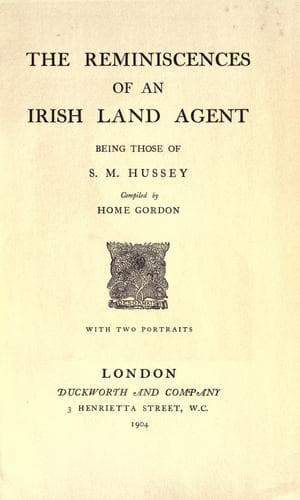
The Reminiscences of an Irish Land AgentHussey, Samuel Murray
History
The Reminiscences of an Irish Land Agent
Hussey, Samuel Murray
Country life -- Ireland; Hussey, Samuel Murray, 1824-; Ireland -- History -- 1837-1901
'We are not ready to accede to a principle of legislation by which the
State shall take into its own hands the valuation of rent throughout
Ireland. I say, "take into its own hands" because it is perfectly
immaterial whether the thing shall be done by a State officer forming
part of the Civil Service, or by an arbitration acting under State
authority, or by any other person invested by the law with power to
determine on what terms as to rent every holding in Ireland shall be
held.'
This categorical denunciation of the principle which he was then asked,
and which he peremptorily refused to sanction, was not enough for Mr.
Gladstone, for the records of debate show he went farther, but enough
has been cited to show that never was prophecy more fully fulfilled.
Outrage followed outrage with a rapidity unequalled in Europe, and that
in a country which previous to his remedial measures had practically
been unstained by an agrarian outrage for fifty years.
It would certainly be both remiss of me, and altogether below the
character which I trust I have acquired for honest plain speaking, if I
omitted to give my views upon Mr. Wyndham's Act, for those readers who
regard my book as something more than a storehouse of anecdotes--and
since it is written at all, I maintain it claims to be more than
that--having noticed the freedom with which I have spoken of previous
English legislation for Ireland, may very naturally think I should be
begging the question of the hour, if I did not offer a few observations
on the latest development of the Irish question.
I must emphatically repeat what I have already asserted:--that the Acts
of Mr. Gladstone rendered a Purchase Bill inevitable, and it fell to Mr.
Wyndham's lot to formulate the scheme which has now become law.
Mr. Wyndham's Act is a great one for Ireland, because where a tenant
previously paid L100 a year rent, all he will have to pay--even at
twenty-four years' purchase--is L80 a year, and at that rate with the
bonus the landlord obtains twenty-seven years' purchase. But this scale
is a little halcyon in most instances.
It should prove a boon to the country, and it is the necessary outcome
of the Land Act of 1881, by which rents were cut down by commissioners,
whose means of living depended on the reductions they made.
And to make this state of things yet more remarkable, there were two
courts established for fixing rates. The one consisted of
sub-commissioners, who were paid by the year, and the other was that of
the County Court judge, who was wholly dependent on a valuer paid by the
day.
So, whoever cut down the most earned the most.
A valuer in Limerick was remonstrated with for cutting down local rents
so low, and he replied:--
'It is all for the good of trade, for it will bring every tenant into
the Court.'
And so it actually did, for that Court very shortly afterwards was chock
full of cases.
Public-domain text, read in full here on John Shaqi.
Reviews
Reviews
No reviews yet
Be the first to share your thoughts on this work.
Elsewhere in the archive
Join the Discussion
Join the discussion
Sign in to leave a comment or review.
Sign InorCreate an account