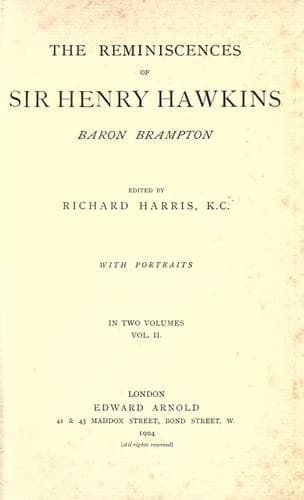
The Reminiscences of Sir Henry Hawkins (Baron Brampton)Brampton, Henry Hawkins, Baron
History
The Reminiscences of Sir Henry Hawkins (Baron Brampton)
Brampton, Henry Hawkins, Baron
Brampton, Henry Hawkins, Baron, 1817-1907; Judges -- Great Britain -- Biography
Insanity on the ground of absence of motive was set up as a matter of
course, but insanity should be based on proof apart from the cruelty
of the act itself. It was a premeditated crime, a bloodthirsty desire
to wreak his malice on some one; but beyond the act, beyond the
malignant disposition of the man, there was no evidence whatever of
insanity.
I refused to recommend him to the Royal clemency on that ground, or on
any ground, for there was not the smallest pretence for saying it was
not a deliberate cold-blooded murder. And the man was rightly hanged.
Society should be protected from murderers. This may be hard dealing
with the enemies of society, but it is just to society itself. I was
never hard on a prisoner. The least circumstance in mitigation found
in me a hearty reception, but cruelty in man or woman an unflinching
Judge.
Take another case. In Gloucestershire a man was convicted of killing a
girl by stabbing her in no less than thirty-eight places.
Again the humanitarians besieged the Home Secretary. "No man in his
senses would have been so cruel; and there was his conduct in the
dock: he was so wild, so incoherent. There was also his conduct in the
field where he had committed the deed: he called the attention of the
passers-by to his having killed her." And, last of all, "there was the
doctor whom the Home Secretary had consulted after the trial."
I was appealed to, and stated my opinion honestly: that I had closely
watched the man at the trial, and was satisfied that he was shamming
insanity.
And he shammed it so awkwardly that there was no doubt whatever that
he was sane.
Another Judge was asked about the case who saw only the evidence, and
he came to the same conclusion; and I was compelled to report that the
doctor who certified that he was insane did so _without having seen
him_ as the doctors for the prosecution had at the trial and before.
He was hanged.
CHAPTER XXXV.
THE ST. NEOTS CASE.
This is the last trial for murder that I presided over. The object is
not to show the horrible details of the deed, but my mode of dealing
with the facts, for it is in the elimination of the false from the
true that the work of a Judge must consist, otherwise his office is a
useless form. I shall give this case, therefore, more in detail than I
otherwise should.
The case was that of Horsford, in the year 1898, at Huntingdon
Assizes. I say now, long after the event, the murderer was not
improperly described by the _Daily News_ as the greatest monster of
our criminal annals, and yet even in that case some kind-hearted
people said I had gone quite _to the limits of a Judge's rights_ in
summing up the case. Let me say a word about circumstantial evidence.
Some writers have spoken of it as a kind of "dangerous innovation in
our criminal procedure." It is actually almost the only evidence
that is obtainable in all great crimes, and it is the best and most
reliable.
Public-domain text, read in full here on John Shaqi.
Reviews
Reviews
No reviews yet
Be the first to share your thoughts on this work.
Elsewhere in the archive
Join the Discussion
Join the discussion
Sign in to leave a comment or review.
Sign InorCreate an account