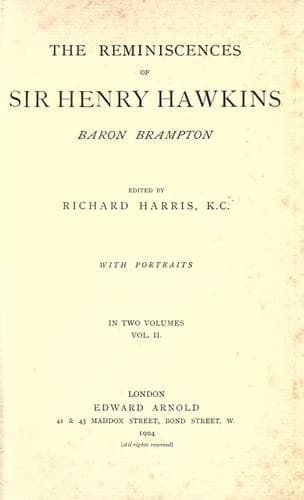
The Reminiscences of Sir Henry Hawkins (Baron Brampton)Brampton, Henry Hawkins, Baron
History
The Reminiscences of Sir Henry Hawkins (Baron Brampton)
Brampton, Henry Hawkins, Baron
Brampton, Henry Hawkins, Baron, 1817-1907; Judges -- Great Britain -- Biography
You may draw wrong impressions from it, I grant, but so you may from
the evidence of witnesses where it is _doubtful_; but you cannot fail
to draw the right ones where the facts are not doubtful. If it is
capable of a wrong inference, a Judge should be absolutely positive in
his direction to the jury not to draw it.
I have witnessed many great trials for murder, but do not remember one
where there was an eye-witness to the deed. How is it possible,
then, to bring home the charge to the culprit unless you rely on
circumstantial evidence? Circumstantial evidence is the evidence of
circumstances--facts that speak for themselves and that cannot be
contradicted. Circumstances have no motive to deceive, while human
testimony is too often the product of every kind of motive.
The history of this case is extremely simple. The accused, Walter
Horsford, aged thirty-six, was a farmer of Spaldwick. The person
murdered, Annie Holmes, was a widow whose age was thirty-eight years.
She had resided for several months at St. Neots, where she died on
the night of January 7. She had been married, and lost her husband
thirteen years ago. On his death he left two children, Annie and
Percy. The latter was sixteen years of age and the girl fourteen.
The prisoner was a cousin of the deceased woman. While she lived at
Stonely the man had been in the habit of visiting her, and had become
an intimate member of the family.
In the month of October the prisoner was married to a young woman
named Bessie ----. The widow with her two children, and a third, which
it would be idle affectation to suggest was the offspring of her late
husband, went to reside at St. Neots in a cottage rented at about £8 a
year. The prisoner wrote to Annie Holmes on at least two occasions.
Towards the close of the year Annie Holmes suspected herself to be
pregnant. She was anxious not to bring another child into the world,
and had some communication with the prisoner on the subject.
On January 5 he wrote to her that he would come and make some
arrangement. The woman was deceived as to her condition, but that made
no difference with regard to the crime. The letter went on to state:
"You must remember I paid you for what I done.... Don't write any more
letters, for I don't want Bessie to know."
Public-domain text, read in full here on John Shaqi.
Reviews
Reviews
No reviews yet
Be the first to share your thoughts on this work.
Elsewhere in the archive
Join the Discussion
Join the discussion
Sign in to leave a comment or review.
Sign InorCreate an account