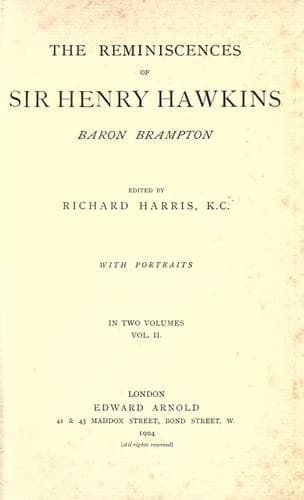
The Reminiscences of Sir Henry Hawkins (Baron Brampton)Brampton, Henry Hawkins, Baron
History
The Reminiscences of Sir Henry Hawkins (Baron Brampton)
Brampton, Henry Hawkins, Baron
Brampton, Henry Hawkins, Baron, 1817-1907; Judges -- Great Britain -- Biography
"Again, as to motive, upon which so much stress has been laid by the
defendant's counsel. If the prisoner had no motive, who else had? Is
there a human being on earth who had ill-will towards her, or anything
to gain by her death? The learned counsel carefully avoided suggesting
any one; nor could he suggest that any one in the neighbourhood wrote
the same handwriting as the prisoner. I will dismiss the theory that
some one had imitated the prisoner's writing in order to do him an
injury, and ask if you can see any reason for any one else giving the
woman the powder.
"There is one fact beyond all dispute: in December the prisoner bought
a shilling's worth of strychnine. He said he bought it for rats, but
no one on the farm had been called to prove it. What has been done
with the rest of the powder?
"Where was he on that Friday? His counsel said he could not prove an
_alibi_. But if he was at Spaldwick after saying he was going to St.
Neots to see this poor woman, he _could_ have proved it.
"The prisoner's counsel said that the accused did not speak of the
woman's murder after the inquest, and said it was not necessary; he
did not understand the 'familiar jargon' of the Law Courts.
"The familiar jargon of the Law Courts, gentlemen, is not quite the
phrase to use with reference to our judicial proceedings. The Law
Courts are the bulwark of our liberties, our life, and our property.
Our welfare would be jeopardized, indeed, if you dismiss what takes
place in them as 'familiar jargon.'
"The question is whether the charge has been so reasonably brought
home to the prisoner as to lead you in your consciences to believe
that he is guilty. If so, it is your duty to God, your duty to
society, and your duty to yourselves, to say so."
Such was the summing up that was arraigned by the humanitarian
partisans of the prisoner. If a Judge may not deal with the fallacies
of a defence by placing before the jury the true trend of the
evidence, what other business has he on the Bench? And it was for thus
clearly defining the issue that some one suggested a petition for a
reprieve, on the ground that the evidence was _purely circumstantial_,
and that my "summing up was against _the weight of the evidence_."
Truly a strange thing that circumstances by themselves shall have no
weight.
But there was another strange incident in this remarkable trial: _the
jury thanked me for the pains I had taken in the case_. I told them I
looked for no thanks, but was grateful, nevertheless.
I have learnt that the jury, on retiring, deposited every one on a
slip of paper the word "Guilty" without any previous consultation--a
sufficient indication of their opinion of the _weight_ of the
evidence.
This was the last case of any importance which I tried on circuit, and
if any trial could show the value of circumstantial evidence, it was
this one. It left the identity of the prisoner and the conclusion of
fact demonstrable almost to mathematical certainty.
Public-domain text, read in full here on John Shaqi.
Reviews
Reviews
No reviews yet
Be the first to share your thoughts on this work.
Elsewhere in the archive
Join the Discussion
Join the discussion
Sign in to leave a comment or review.
Sign InorCreate an account