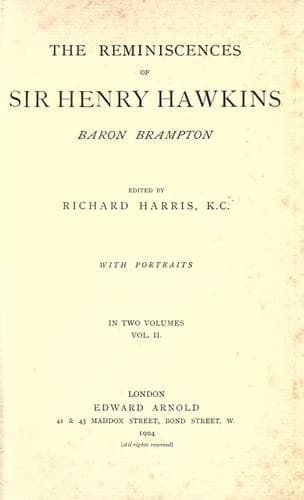
The Reminiscences of Sir Henry Hawkins (Baron Brampton)Brampton, Henry Hawkins, Baron
History
The Reminiscences of Sir Henry Hawkins (Baron Brampton)
Brampton, Henry Hawkins, Baron
Brampton, Henry Hawkins, Baron, 1817-1907; Judges -- Great Britain -- Biography
"I have not admitted a statement which the woman made while in her
dying state, because she may not fully have realized her condition.
Probably you will have no doubt that, by whomsoever this fatal dose
was administered, there is only known to medical science one poison
which will produce the symptoms of this woman's dying agonies. One
thing is surprising at this stage--that immediately after death the
door of the house was not locked, and while the body was upon the
bed a paper of no importance was found, and that afterwards several
relatives went in. The object of the cross-examination was to show
that some evil-disposed person had entered the house and placed things
there _without any motive_. But whoever may have gone into that house,
there was one person who _did not go_--one who, above all others, owed
deceased some respect--and that is the prisoner; and unless you can
wipe out the half-crown letter from your mind, you would have expected
a man on those intimate terms with the poor woman to have gone and
made some inquiries concerning her death. He did not go; he was at the
Falcon Hotel at Huntingdon, and a telegram was sent telling him to
fail not to be at the inquest.
"At the inquest he told a deliberate lie, for he swore he had never
written to the woman, or sent her anything, or been on familiar terms
with her. He had written to her, and if his letter did not prove
familiar terms, there was no meaning in language.
"With regard to the prisoner's alleged handwriting on the packets and
papers found under the woman's bed and elsewhere, I must point out to
you that here is one on which is written, 'Take in a little water; it
is quite harmless. Will come over in a day or two.'
"This was written on a buff paper, which Dr. Stevenson said must have
contained 35 grains of strychnine, sufficient to kill thirty-five
persons, and the direction written was, 'One dose; take as told.'
"These inscriptions were sworn to by experts as being in the
prisoner's handwriting."
Here I pointed out the alleged resemblances in the characters of the
letters, so that the jury might judge if the prisoner wrote them.
"If the prisoner wrote the words 'take as told,' you must ask
yourselves the meaning of it.
"Also, you will ask whether it was not a little strange that the death
occurred on that very Friday night when he said he would go over and
see her. Again, the word 'harmless' is of the gravest character,
seeing that within the folds of that paper were 35 grains of a deadly
powder, which even for rat-powder would be mixed with something else.
Public-domain text, read in full here on John Shaqi.
Reviews
Reviews
No reviews yet
Be the first to share your thoughts on this work.
Elsewhere in the archive
Join the Discussion
Join the discussion
Sign in to leave a comment or review.
Sign InorCreate an account