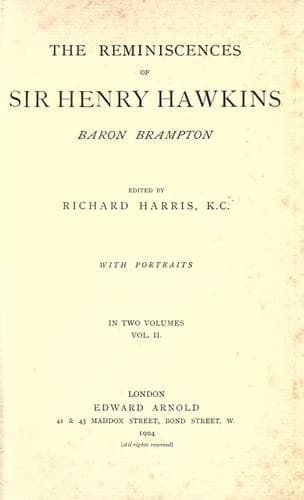
The Reminiscences of Sir Henry Hawkins (Baron Brampton)Brampton, Henry Hawkins, Baron
History
The Reminiscences of Sir Henry Hawkins (Baron Brampton)
Brampton, Henry Hawkins, Baron
Brampton, Henry Hawkins, Baron, 1817-1907; Judges -- Great Britain -- Biography
A man was charged with robbing another who was in custody in charge
of the police for "welshing." The prisoner had undoubtedly, while the
prosecutor, as I will call him, was in custody, and being led along
the course, rushed up to him, after jumping the barriers, and put
his hand in his coat-pocket, pulling out his pocket-book and other
articles. He then made off, but was pursued by the police and
arrested. He was indicted for the robbery, and the facts were
undisputed.
There was no defence set up, and I was about to ask the jury for their
opinion on the case, which certainly had a very extraordinary aspect.
Suddenly the prisoner blurted out, as excusing himself,--
"Well, sir, _he asked me to take the things_. I was a stranger to him,
and the mob was turning his pockets inside out and ill-treating him
for welshing."
I immediately asked the prosecutor, "Is that true?" and he answered,
"Yes." The prisoner said, "I only did it to protect his things for
him."
Of course I instantly stopped the case and directed an acquittal.
I then gave both parties a little advice. To the prosecutor (the
welsher) I said, "Don't go welshing any more;" and to the prisoner,
"If you ever again see a welsher in distress, don't help him."
I should like to say one word more. It should not be supposed that
a man, when sentenced, is altogether bad because he uses insulting
language to the Judge. He may not be utterly bad and past all hope of
redemption on that account.
The want of even an approach to uniformity in criminal sentences is
no doubt a very serious matter, and is due, not to any defect in
the criminal law (much as I think that might be improved in many
respects), but is owing to the great diversity of opinion, and
therefore of action, which not unnaturally exists among criminal
Judges, from the highest to the humblest, numbering, as they do,
at least 5,000 personages, including Judges of the High Courts,
commissioners, recorders, police magistrates, and justices of the
peace.
When one considers the conditions under which the criminal law is
administered in England, and remembers that no fixed principles upon
which punishments should be awarded have been authoritatively laid
down, and that the law has stated only a maximum (but happily at the
present time not a minimum), and each Judge is left practically at
liberty to exercise his own unfettered discretion so long as he
confines himself within the limit so prescribed, it is no matter for
wonder that so great a diversity of punishment should follow so great
a variety of opinion.
Even in the most accurate and useful books of practice to which all
look for guidance and assistance during every stage of the criminal
proceedings, down to the conviction of the offender, no serious
attempt has been made to deal, even in the most general way, with the
mode in which the appropriate sentence should be arrived at.
Public-domain text, read in full here on John Shaqi.
Reviews
Reviews
No reviews yet
Be the first to share your thoughts on this work.
Elsewhere in the archive
Join the Discussion
Join the discussion
Sign in to leave a comment or review.
Sign InorCreate an account