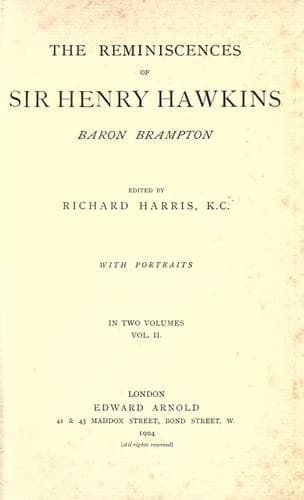
The Reminiscences of Sir Henry Hawkins (Baron Brampton)Brampton, Henry Hawkins, Baron
History
The Reminiscences of Sir Henry Hawkins (Baron Brampton)
Brampton, Henry Hawkins, Baron
Brampton, Henry Hawkins, Baron, 1817-1907; Judges -- Great Britain -- Biography
The result of this state of things is extremely unsatisfactory, and
the most glaring irregularities, diversity, and variety of sentences
are daily brought to our notice, the same offence committed under
similar circumstances being visited by one Judge with a long term of
penal servitude, by another with simple imprisonment, with nothing
appreciable to account for the difference.
In one or the other of these sentences discretion must have been
erroneously exercised. I have seen such diversity even between Judges
of profound learning in the law who might not unreasonably, _primâ
facie_, be pointed to as safe examples to be followed; and so they
were, so far as regarded their legal utterances. Experience, however,
has told us that the profoundest lawyers are not always the best
administrators of the criminal law.
Practically there are now no criminal offences which can be visited
with the penalty of death. Treason and murder still remain. For the
latter offence the Judge is _bound to pronounce sentence of death_,
which is imperatively fixed and ordained by Act of Parliament, and any
other sentence would be illegal.
There are certain principles which I consider ought never to be lost
sight of.
In the first place, it must be remembered that for mere immorality,
not made criminal by the common or statute law of the land, no
punishment can be legally inflicted, and, in my opinion, no crime
ought to be visited with a heavier punishment merely because it is
also against the laws of God.
Take, for example, the crime of unlawfully knowing a girl under
the age of sixteen years, even with consent. Assume that with her
invitation the man committed himself. Go further, and establish the
sin of incest. The latter sin ought to be _totally ignored_ in dealing
with the _statutory_ offence.
I must not, however, be understood as intending my observations to
apply to cases where the immorality is in itself an _element_ of the
crime. My view is that the rule ought to apply only in cases where
the immorality is only a sin against God, and is severable from the
_crime_ committed against the laws of the land.
The case I have suggested is an illustration of what I mean.
Secondly, a sentence ought never to be so severe as to create in the
mind of reasonable persons, having knowledge of the circumstances, a
sympathy with the criminal, for that tends to bring the administration
of the law into discredit, and while giving a Judge credit for having
acted with the strictest sense of justice, it might give rise to a
suspicion of his fitness and qualifications for the administration of
the criminal law--a state of things which ought to be avoided.
The same observations apply, but not with equal force, to sentences
which may to reasonable persons acquainted with all the circumstances
appear to be ridiculously light, for it is more consistent with our
laws to err on the side of mercy than on the side of severity.
Public-domain text, read in full here on John Shaqi.
Reviews
Reviews
No reviews yet
Be the first to share your thoughts on this work.
Elsewhere in the archive
Join the Discussion
Join the discussion
Sign in to leave a comment or review.
Sign InorCreate an account