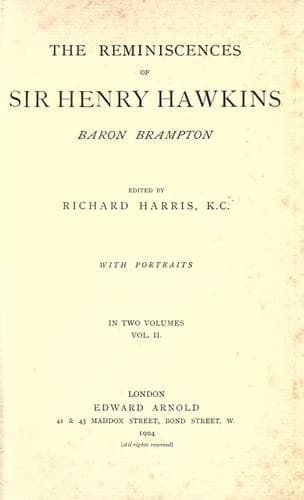
The Reminiscences of Sir Henry Hawkins (Baron Brampton)Brampton, Henry Hawkins, Baron
History
The Reminiscences of Sir Henry Hawkins (Baron Brampton)
Brampton, Henry Hawkins, Baron
Brampton, Henry Hawkins, Baron, 1817-1907; Judges -- Great Britain -- Biography
The object of criminal sentences is to compel the observance by all
persons, high and low, rich and poor, of those public rights and
privileges, both as regards the persons and property common to all
their fellow-subjects, the infringement of which is made criminal.
For the infringement of other rights of a private character the law
has provided civil remedies with which we are not at this moment
concerned.
Punishments, then, should be administered only as a necessary sequence
to the breach of a _criminal_ law, with the object of deterring the
offender from repeating his offence.
Of necessity it operates to some extent as a warning to others; but
that is not its primary object, for no punishment ought to exceed in
severity that which is due to the particular offence to which it is
applied. To add to a sentence for a very venial offence for which
a nominal punishment ought to suffice an extra fine or term of
imprisonment by way of example or warning to others would be
unreasonable and unjust. Vengeance, or the infliction of unnecessary
pain, especially for the sake of others, should never form part of a
criminal sentence.
Reformation of the criminal by and during his imprisonment should
be one chief object of his punishment, but a just sentence for the
offence is not to be prolonged either for education or reformation,
unless expressly sanctioned by law, as in the case of reformatories.
With regard to crimes of violence, it sometimes happens that long
periods of restraint and imprisonment are imperative--where, for
instance, the criminal is persistent in his threats, or has made
it evident by his actions or words that on his liberation from
imprisonment for criminal violence he intends to resume his criminal
course, and will do so unless restrained.
Take, for instance, the case of a persistent burglar, the great
majority of whose robberies are committed under circumstances
calculated to create terror and alarm, and upon whom imprisonment,
however long, has no restraining effect after his liberation. Take the
confirmed highway robber, who to secure his booty does not scruple to
use deadly violence upon his victim. It is rare that one short term
of imprisonment, or the fear of another, induces him to abandon his
criminal course. In such cases it is essential for the protection
of the public that he should no longer be at liberty to pursue his
dangerous and alarming course of life. For him, therefore, a much
longer term of restraint is necessary than in the case of mere
pilferers, whose thefts, although causing loss and vexation, are not
productive of personal injury.
Lastly, I am strongly averse from abolishing the sentence of death in
cases of deliberate murder. Even when the crime is committed under the
influence of jealousy, I should take little pains to save the life
of one who had cruelly and deliberately murdered another for the
gratification of revenge or the purpose of robbery.
Public-domain text, read in full here on John Shaqi.
Reviews
Reviews
No reviews yet
Be the first to share your thoughts on this work.
Elsewhere in the archive
Join the Discussion
Join the discussion
Sign in to leave a comment or review.
Sign InorCreate an account