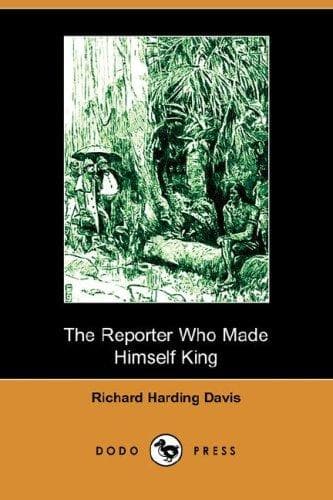
The Reporter Who Made Himself KingDavis, Richard Harding
General
The Reporter Who Made Himself King
Davis, Richard Harding
Journalists -- 19th century -- Fiction; Short stories
Stedman seated himself in the long grass in front of the King, and with
many revolving gestures of his arms, and much pointing at Gordon, and
profound nods and bows, retold what Gordon had dictated. When he had
finished, the King looked at the bundle of presents, and at the guns,
of which Stedman had given a very wonderful account, but answered
nothing.
"I guess," said Stedman, with a sigh, "that we will have to give him a
little practical demonstration to help matters. I am sorry, but I
think one of those goats has got to die. It's like vivisection. The
lower order of animals have to suffer for the good of the higher."
"Oh," said Bradley, Jr., cheerfully, "I'd just as soon shoot one of
those niggers as one of the goats."
So Stedman bade the King tell his men to drive a goat toward them, and
the King did so, and one of the men struck one of the goats with his
spear, and it ran clumsily across the plain.
"Take your time, Bradley," said Gordon. "Aim low, and if you hit it,
you can have it for supper."
"And if you miss it," said Stedman, gloomily, "Messenwah may have us
for supper."
The Hillmen had seated themselves a hundred yards off, while the
leaders were debating, and they now rose curiously and watched Bradley,
as he sank upon one knee, and covered the goat with his rifle. When it
was about one hundred and fifty yards off he fired, and the goat fell
over dead.
And then all the Hillmen, with the King himself, broke away on a run,
toward the dead animal, with much shouting. The King came back alone,
leaving his people standing about and examining the goat. He was much
excited, and talked and gesticulated violently.
"He says--" said Stedman; "he says----"
"What? yes, go on."
"He says--goodness me!--what do you think he says?"
"Well, what does he say?" cried Gordon, in great excitement. "Don't
keep it all to yourself."
"He says," said Stedman, "that we are deceived; that he is no longer
King of the Island of Opeki; that he is in great fear of us, and that
he has got himself into no end of trouble. He says he sees that we are
indeed mighty men, that to us he is as helpless as the wild boar before
the javelin of the hunter."
"Well, he's right," said Gordon. "Go on."
"But that which we ask is no longer his to give. He has sold his
kingship and his right to this island to another king, who came to him
two days ago in a great canoe, and who made noises as we do--with guns,
I suppose he means--and to whom he sold the island for a watch that he
has in a bag around his neck. And that he signed a paper, and made
marks on a piece of bark, to show that he gave up the island freely and
forever."
"What does he mean?" said Gordon. "How can he give up the island?
Ollypybus is the king of half of it, anyway, and he knows it."
Public-domain text, read in full here on John Shaqi.
Reviews
Reviews
No reviews yet
Be the first to share your thoughts on this work.
Join the Discussion
Join the discussion
Sign in to leave a comment or review.
Sign InorCreate an account