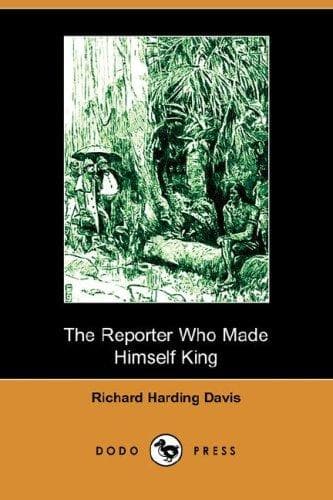
The Reporter Who Made Himself KingDavis, Richard Harding
General
The Reporter Who Made Himself King
Davis, Richard Harding
Journalists -- 19th century -- Fiction; Short stories
"If I've got to serve a term of imprisonment on a rock in the middle of
the ocean for four years," he said, "I might just as well have done
something first to deserve it. This is a pretty way to treat a man who
bled for his country. This is gratitude, this is." Albert pulled
heavily on his pipe, and wiped the rain and spray from his face and
smiled.
"Oh, it won't be so bad when we get there," he said; "they say these
Southern people are always hospitable, and the whites will be glad to
see anyone from the States."
"There will be a round of diplomatic dinners," said the consul, with an
attempt at cheerfulness. "I have brought two uniforms to wear at them."
It was seven o'clock in the evening when the rain ceased, and one of
the black, half-naked fishermen nodded and pointed at a little low line
on the horizon.
"Opeki," he said. The line grew in length until it proved to be an
island with great mountains rising to the clouds, and, as they drew
nearer and nearer, showed a level coast running back to the foot of the
mountains and covered with a forest of palms. They next made out a
village of thatched huts around a grassy square, and at some distance
from the village a wooden structure with a tin roof.
"I wonder where the town is," asked the consul, with a nervous glance
at the fishermen. One of them told him that what he saw was the town.
"That?" gasped the consul. "Is that where all the people on the island
live?"
The fisherman nodded; but the other added that there were other natives
further back in the mountains, but that they were bad men who fought
and ate each other. The consul and his attache of legation gazed at
the mountains with unspoken misgivings. They were quite near now, and
could see an immense crowd of men and women, all of them black, and
clad but in the simplest garments, waiting to receive them. They
seemed greatly excited and ran in and out of the huts, and up and down
the beach, as wildly as so many black ants. But in the front of the
group they distinguished three men who they could see were white,
though they were clothed, like the others, simply in a shirt and a
short pair of trousers. Two of these three suddenly sprang away on a
run and disappeared among the palm-trees; but the third one, when he
recognized the American flag in the halyards, threw his straw hat in
the water and began turning handsprings over the sand.
"That young gentleman, at least," said Albert, gravely, "seems pleased
to see us."
A dozen of the natives sprang into the water and came wading and
swimming toward them, grinning and shouting and swinging their arms.
"I don't think it's quite safe, do you?" said the consul, looking out
wildly to the open sea. "You see, they don't know who I am."
A great black giant threw one arm over the gunwale and shouted
something that sounded as if it were spelt Owah, Owah, as the boat
carried him through the surf.
Public-domain text, read in full here on John Shaqi.
Reviews
Reviews
No reviews yet
Be the first to share your thoughts on this work.
Join the Discussion
Join the discussion
Sign in to leave a comment or review.
Sign InorCreate an account