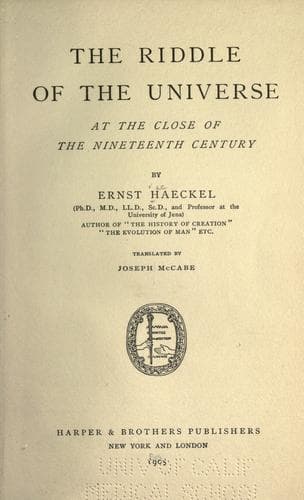
The Riddle of the Universe at the close of the nineteenth centuryHaeckel, Ernst
Religion
The Riddle of the Universe at the close of the nineteenth century
Haeckel, Ernst
Evolution; Monism; Religion and science; Soul
From the fact that consciousness, like all other psychic functions,
is dependent on the normal development of certain organs, and that
it gradually unfolds in the child in proportion to the development
of those organs, we may already conclude that it has arisen in the
animal kingdom by a gradual historical development. Still, however
certain we are of the fact of this natural evolution of consciousness,
we are, unfortunately, not yet in a position to enter more deeply
into the question and construct special hypotheses in elucidation
of it. Palæontology, it is true, gives us a few facts which are not
without significance. For instance, the quantitative and qualitative
development of the brain of the placental mammals during the Tertiary
period is very remarkable. The cavity of many of the fossil skulls of
the period has been carefully examined, and has given us a good deal of
reliable information as to the size, and, to some extent, as to the
structure, of the brain they enclosed. We find, within the limits of
one and the same group (the ungulates, the rodents, or the primates), a
marked advance in the later miocene and pliocene specimens as compared
with the earlier eocene and oligocene representatives of the same stem;
in the former the brain (in proportion to the size of the organism) is
six to eight times as large as in the latter.
Moreover, that highest stage of consciousness, which is reached by man
alone, has been evolved step by step--even by the very progress of
civilization--from a lower condition, as we find illustrated to-day in
the case of uncivilized races. That is easily proved by a comparison
of their languages, which is closely connected with the comparison of
their ideas. The higher the conceptual faculty advances in thoughtful
civilized man, the more qualified he is to detect common features amid
a multitude of details, and embody them in general concepts, and so
much the clearer and deeper does his consciousness become.
CHAPTER XI
THE IMMORTALITY OF THE SOUL
The Citadel of Superstition--Athanatism and Thanatism--Individual
Character of Death--Immortality of the Unicellular Organisms
(Protists)--Cosmic and Personal Immortality--Primary Thanatism (of
Uncivilized Peoples)--Secondary Thanatism (of Ancient and Recent
Philosophers)--Athanatism and Religion--Origin of the Belief
in Immortality--Christian Athanatism--Eternal Life--The Day of
Judgment--Metaphysical Athanatism--Substance of the Soul--Ether
Souls and Air Souls; Fluid Souls and Solid Souls--Immortality of
the Animal Soul--Arguments for and Against Athanatism--Athanatist
Illusions
Public-domain text, read in full here on John Shaqi.
Reviews
Reviews
No reviews yet
Be the first to share your thoughts on this work.
Elsewhere in the archive
Join the Discussion
Join the discussion
Sign in to leave a comment or review.
Sign InorCreate an account