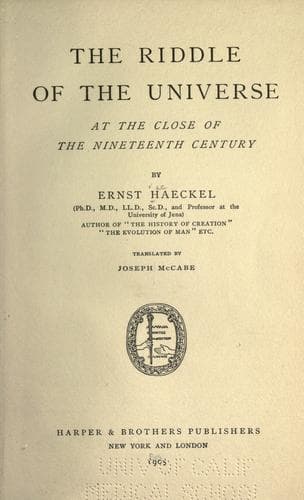
The Riddle of the Universe at the close of the nineteenth centuryHaeckel, Ernst
Religion
The Riddle of the Universe at the close of the nineteenth century
Haeckel, Ernst
Evolution; Monism; Religion and science; Soul
When we turn from the genetic study of the soul to the great question
of its immortality, we come to that highest point of superstition which
is regarded as the impregnable citadel of all mystical and dualistic
notions. For in this crucial question, more than in any other problem,
philosophic thought is complicated by the selfish interest of the human
personality, who is determined to have a guarantee of his existence
beyond the grave at any price. This "higher necessity of feeling" is
so powerful that it sweeps aside all the logical arguments of critical
reason. Consciously or unconsciously, most men are influenced in all
their general views, and, therefore, in their theory of life, by the
dogma of personal immortality; and to this theoretical error must be
added practical consequences of the most far-reaching character. It is
our task, therefore, to submit every aspect of this important dogma to
a critical examination, and to prove its untenability in the light of
the empirical data of modern biology.
In order to have a short and convenient expression for the two opposed
opinions on the question, we shall call the belief in man's personal
immortality "athanatism" (from _athanes_ or _athanatos_ == immortal).
On the other hand, we give the name of "thanatism" (from _thanatos_
== death) to the opinion which holds that at a man's death not only
all the other physiological functions are arrested, but his "soul"
also disappears--that is, that sum of cerebral functions which psychic
dualism regards as a peculiar entity, independent of the other vital
processes in the living body.
In approaching this physiological problem of death we must point out
the _individual_ character of this organic phenomenon. By death we
understand simply the definitive cessation of the vital activity of
the _individual_ organism, no matter to which category or stage of
individuality the organism in question belongs. Man is dead when his
own personality ceases to exist, whether he has left offspring that
they may continue to propagate for many generations or not. In a
certain sense we often say that the minds of great men (in a dynasty
of eminent rulers, for instance, or a family of talented artists) live
for many generations; and in the same way we speak of the "soul" of
a noble woman living in her children and children's children. But in
these cases we are dealing with intricate phenomena of _heredity_,
in which a microscopic cell (the sperm-cell of the father or the
egg-cell of the mother) transmits certain features to offspring. The
particular personalities who produce those sexual cells in thousands
are mortal beings, and at their death their personal psychic activity
is extinguished like every other physiological function.
Public-domain text, read in full here on John Shaqi.
Reviews
Reviews
No reviews yet
Be the first to share your thoughts on this work.
Elsewhere in the archive
Join the Discussion
Join the discussion
Sign in to leave a comment or review.
Sign InorCreate an account