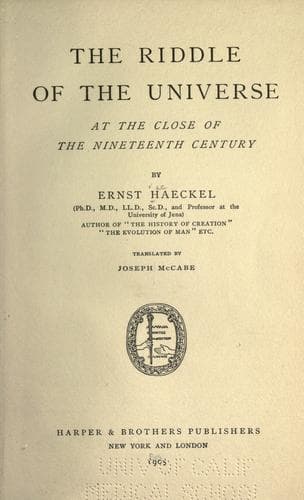
The Riddle of the Universe at the close of the nineteenth centuryHaeckel, Ernst
Religion
The Riddle of the Universe at the close of the nineteenth century
Haeckel, Ernst
Evolution; Monism; Religion and science; Soul
A critical comparison of the countless and manifold fantasies which
belief in immortality has produced during the last few thousand years
in the different races and religions yields a most remarkable picture.
An intensely interesting presentation of it, based on most extensive
original research, may be found in Adalbert Svoboda's distinguished
works, _The Illusion of the Soul_ and _Forms of Faith_. However absurd
and inconsistent with modern knowledge most of these myths seem to be,
they still play an important part, and, as "postulates of practical
reason," they exercise a powerful influence on the opinions of
individuals and on the destiny of races.
The idealist and spiritualist philosophy of the day will freely grant
that these prevalent materialistic forms of belief in immortality are
untenable; it will say that the refined idea of an immaterial soul,
a Platonic "idea" or a transcendental psychic substance, must be
substituted for them. But modern realism can have nothing whatever to
do with these incomprehensible notions; they satisfy neither the mind's
feeling of causality nor the yearning of our emotions. If we take a
comprehensive glance at all that modern anthropology, psychology,
and cosmology teach with regard to athanatism, we are forced to this
definite conclusion: "The belief in the immortality of the human soul
is a dogma which is in hopeless contradiction with the most solid
empirical truths of modern science."
CHAPTER XII
THE LAW OF SUBSTANCE
The Fundamental Chemical Law of the Constancy of Matter--The
Fundamental Physical Law of the Conservation of Energy--Combination
of Both Laws in the Law of Substance--The Kinetic, Pyknotic,
and Dualistic Ideas of Substance--Monism of Matter--Ponderable
Matter--Atoms and Elements--Affinity of the Elements--The Soul of
the Atom (Feeling and Inclination)--Existence and Character of
Ether--Ether and Ponderable Matter--Force and Energy--Potential
and Actual Force--Unity of Natural Forces--Supremacy of the Law of
Substance
The supreme and all-pervading law of nature, the true and only
cosmological law, is, in my opinion, _the law of substance_; its
discovery and establishment is the greatest intellectual triumph of the
nineteenth century, in the sense that all other known laws of nature
are subordinate to it. Under the name of "law of substance" we embrace
two supreme laws of different origin and age--the older is the chemical
law of the "conservation of matter," and the younger is the physical
law of the "conservation of energy."[23] It will be self-evident to
many readers, and it is acknowledged by most of the scientific men of
the day, that these two great laws are essentially inseparable. This
fundamental thesis, however, is still much contested in some quarters,
and we must proceed to furnish the proof of it. But we must first
devote a few words to each of the two laws.
Public-domain text, read in full here on John Shaqi.
Reviews
Reviews
No reviews yet
Be the first to share your thoughts on this work.
Elsewhere in the archive
Join the Discussion
Join the discussion
Sign in to leave a comment or review.
Sign InorCreate an account