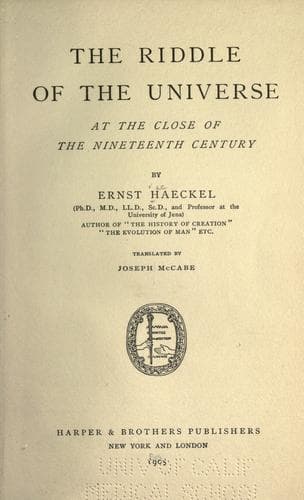
The Riddle of the Universe at the close of the nineteenth centuryHaeckel, Ernst
Religion
The Riddle of the Universe at the close of the nineteenth century
Haeckel, Ernst
Evolution; Monism; Religion and science; Soul
The best and most plausible ground for athanatism is found in the
hope that immortality will reunite us to the beloved friends who have
been prematurely taken from us by some grim mischance. But even this
supposed good fortune proves to be an illusion on closer inquiry; and
in any case it would be greatly marred by the prospect of meeting the
less agreeable acquaintances and the enemies who have troubled our
existence here below. Even the closest family ties would involve many
a difficulty. There are plenty of men who would gladly sacrifice all
the glories of Paradise if it meant the eternal companionship of their
"better half" and their mother-in-law. It is more than questionable
whether Henry VIII. would like the prospect of living eternally with
his six wives; or Augustus the Strong of Poland, who had a hundred
mistresses and three hundred and fifty-two children. As he was on good
terms with the Vicar of Christ, he must be assumed to be in Paradise,
in spite of his sins, and in spite of the fact that his mad military
ventures cost the lives of more than a hundred thousand Saxons.
Another insoluble difficulty faces the athanatist when he asks _in what
stage of their individual development_ the disembodied souls will spend
their eternal life. Will the new-born infant develop its psychic powers
in heaven under the same hard conditions of the "struggle for life"
which educate man here on earth? Will the talented youth who has fallen
in the wholesale murder of war unfold his rich, unused mental powers in
Walhalla? Will the feeble, childish old man, who has filled the world
with the fame of his deeds in the ripeness of his age, live forever in
mental decay? Or will he return to an earlier stage of development?
If the immortal souls in Olympus are to live in a condition of
rejuvenescence and perfectness, then both the stimulus to the formation
of, and the interest in, personality disappear for them.
Not less impossible, in the light of pure reason, do we find the
anthropistic myth of the "last judgment," and the separation of the
souls of men into two great groups, of which one is destined for
the eternal joys of Paradise and the other for the eternal torments
of hell--and that from a personal God who is called the "Father of
Love"! And it is this "Universal Father" who has himself created the
conditions of heredity and adaptation, in virtue of which the elect, on
the one side, were _bound_ to pursue the path towards eternal bliss,
and the luckless poor and miserable, on the other hand, were _driven_
into the paths of the damned?
Public-domain text, read in full here on John Shaqi.
Reviews
Reviews
No reviews yet
Be the first to share your thoughts on this work.
Elsewhere in the archive
Join the Discussion
Join the discussion
Sign in to leave a comment or review.
Sign InorCreate an account