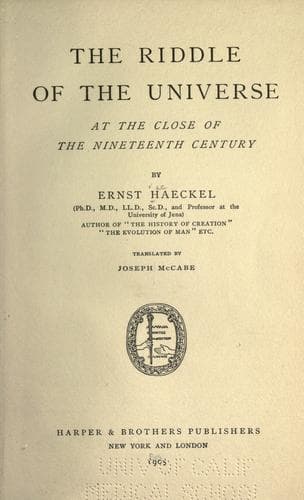
The Riddle of the Universe at the close of the nineteenth centuryHaeckel, Ernst
Religion
The Riddle of the Universe at the close of the nineteenth century
Haeckel, Ernst
Evolution; Monism; Religion and science; Soul
Independently of Mayer, however,
the principle was reached almost at the same time by the famous
physiologist, Hermann Helmholtz; five years afterwards he pointed out
its general application to, and fertility in, every branch of physics.
We ought to say to-day that it rules also in the entire province of
physiology--that is, of "organic physics"; but on that point we meet
a strenuous opposition from the vitalistic biologists and the dualist
and spiritualist philosophers. For these the peculiar "spiritual
forces" of human nature are a group of "free" forces, not subject to
the law of energy; the idea is closely connected with the dogma of the
"freedom of the will." We have, however, already seen (p. 204) that the
dogma is untenable. Modern physics draws a distinction between "force"
and "energy," but our general observations so far have not needed a
reference to it.
The conviction that these two great cosmic theorems, the chemical law
of the persistence of matter and the physical law of the persistence
of force, are fundamentally one, is of the utmost importance in our
monistic system. The two theories are just as intimately united as
their objects--matter and force or energy. Indeed, this fundamental
unity of the two laws is self-evident to many monistic scientists and
philosophers, since they merely relate to two different aspects of one
and the same object, the _cosmos_. But, however natural the thought may
be, it is still very far from being generally accepted. It is stoutly
contested by the entire dualistic philosophy, vitalistic biology,
and parallelistic psychology; even, in fact, by a few (inconsistent)
monists, who think they find a check to it in "consciousness," in the
higher mental activity of man, or in other phenomena of our "free
mental life."
Public-domain text, read in full here on John Shaqi.
Reviews
Reviews
No reviews yet
Be the first to share your thoughts on this work.
Elsewhere in the archive
Join the Discussion
Join the discussion
Sign in to leave a comment or review.
Sign InorCreate an account