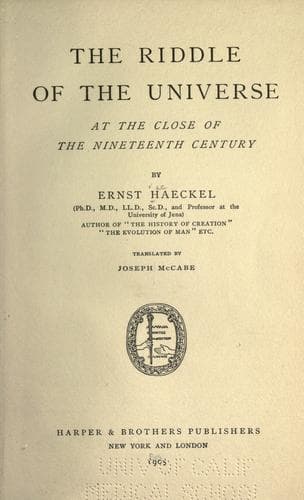
The Riddle of the Universe at the close of the nineteenth centuryHaeckel, Ernst
Religion
The Riddle of the Universe at the close of the nineteenth century
Haeckel, Ernst
Evolution; Monism; Religion and science; Soul
For my part, I am convinced of the profound importance of the unifying
"law of substance," as an expression of the inseparable connection in
reality of two laws which are only separated in conception. That they
were not originally taken together and their unity recognized from
the beginning is merely an accident of the date of their respective
discoveries. The earlier and more accessible chemical law of the
persistence of matter was detected by Lavoisier in 1789, and, after
a general application of the balance, became the basis of exact
chemistry. On the other hand, the more recondite law of the persistence
of force was only discovered by Mayer in 1842, and only laid down
as the basis of exact physics by Helmholtz. The unity of the two
laws--still much disputed--is expressed by many scientists who are
convinced of it in the formula: "Law of the persistence of matter and
force." In order to have a briefer and more convenient expression for
this fundamental thought, I proposed some time ago to call it the "law
of substance" or the "fundamental cosmic law"; it might also be called
the "universal law," or the "law of constancy," or the "axiom of the
constancy of the universe." In the ultimate analysis it is found to be
a necessary consequence of the principle of causality.[24]
The first thinker to introduce the purely monistic conception of
substance into science and appreciate its profound importance was the
great philosopher Baruch Spinoza; his chief work appeared shortly after
his premature death in 1677, just one hundred years before Lavoisier
gave empirical proof of the constancy of matter by means of the
chemist's principal instrument, the balance. In his stately pantheistic
system the notion of the _world_ (the universe, or the cosmos) is
identical with the all-pervading notion of God; it is at one and the
same time the purest and most rational _monism_ and the clearest and
most abstract _monotheism_. This universal substance, this "divine
nature of the world," shows us two different aspects of its being, or
two fundamental attributes--matter (infinitely _extended_ substance)
and spirit (the all-embracing energy of _thought_). All the changes
which have since come over the idea of substance are reduced, on a
logical analysis, to this supreme thought of Spinoza's; with Goethe
I take it to be the loftiest, profoundest, and truest thought of all
ages. Every single object in the world which comes within the sphere
of our cognizance, all individual forms of existence, are but special
transitory forms--_accidents_ or _modes_--of substance. These modes are
material things when we regard them under the attribute of _extension_
(or "occupation of space"), but forces or ideas when we consider them
under the attribute of _thought_ (or "energy"). To this profound
thought of Spinoza our purified monism returns after a lapse of two
hundred years; for us, too, matter (space-filling substance) and energy
Public-domain text, read in full here on John Shaqi.
Reviews
Reviews
No reviews yet
Be the first to share your thoughts on this work.
Elsewhere in the archive
Join the Discussion
Join the discussion
Sign in to leave a comment or review.
Sign InorCreate an account