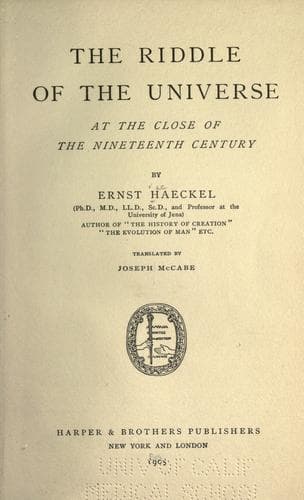
The Riddle of the Universe at the close of the nineteenth centuryHaeckel, Ernst
Religion
The Riddle of the Universe at the close of the nineteenth century
Haeckel, Ernst
Evolution; Monism; Religion and science; Soul
The modern atomistic theory, which is regarded as an indispensable
instrument in chemistry to-day, must be carefully distinguished from
the old philosophic atomism which was taught more than two thousand
years ago by a group of distinguished thinkers of antiquity--Leucippus,
Democritus, and Epicurus: it was considerably developed and modified
later on by Descartes, Hobbes, Leibnitz, and other famous philosophers.
But it was not until 1808 that modern atomism assumed a definite and
acceptable form, and was furnished with an empirical basis by Dalton,
who formulated the "law of simple and multiple proportions" in the
formation of chemical combinations. He first determined the atomic
weight of the different elements, and thus created the solid and exact
foundation on which more recent chemical theories are based; these
are all _atomistic_, in the sense that they assume the elements to be
made up of homogeneous, infinitesimal, distinct particles, which are
incapable of further analysis. That does not touch the question of the
real nature of the atoms--their form, size, psychology, etc. These
atomic qualities are merely hypothetical; while the _chemistry_ of the
atoms, their "chemical affinity"--that is, the constant proportion in
which they combine with the atoms of other elements--is empirical.[25]
The different relation of the various elements towards each other,
which chemistry calls "affinity," is one of the most important
properties of ponderable matter; it is manifested in the different
relative quantities or proportions of their combination in the
intensity of its consummation. Every shade of inclination, from
complete indifference to the fiercest passion, is exemplified in the
chemical relation of the various elements towards each other, just
as we find in the psychology of man, and especially in the life of
the sexes. Goethe, in his classical romance, _Affinities_, compared
the relations of pairs of lovers with the phenomenon of the same name
in the formation of chemical combinations. The irresistible passion
that draws Edward to the sympathetic Ottilia, or Paris to Helen, and
leaps over all bounds of reason and morality, is the same powerful
"unconscious" attractive force which impels the living spermatozoon to
force an entrance into the ovum in the fertilization of the egg of the
animal or plant--the same impetuous movement which unites two atoms
of hydrogen to one atom of oxygen for the formation of a molecule of
water. This fundamental _unity of affinity in the whole of nature_,
from the simplest chemical process to the most complicated love story,
was recognized by the great Greek scientist, Empedocles, in the fifth
century B.C., in his theory of "the love and hatred of the elements."
It receives empirical confirmation from the interesting progress of
cellular psychology, the great significance of which we have only
learned to appreciate in the last thirty years. On those phenomena we
Public-domain text, read in full here on John Shaqi.
Reviews
Reviews
No reviews yet
Be the first to share your thoughts on this work.
Elsewhere in the archive
Join the Discussion
Join the discussion
Sign in to leave a comment or review.
Sign InorCreate an account