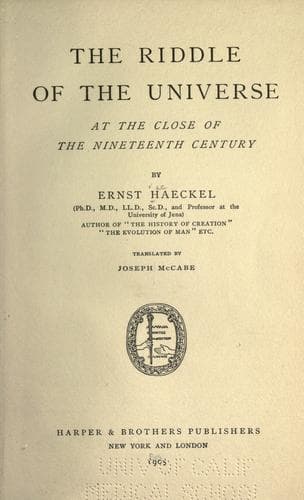
The Riddle of the Universe at the close of the nineteenth centuryHaeckel, Ernst
Religion
The Riddle of the Universe at the close of the nineteenth century
Haeckel, Ernst
Evolution; Monism; Religion and science; Soul
The study of ponderable matter is primarily the concern of chemistry.
Few are ignorant of the astonishing theoretical progress which this
science has made in the course of the century and the immense practical
influence it has had on every aspect of modern life. We shall confine
ourselves here to a few remarks on the more important questions
which concern the nature of ponderable matter. It is well known that
analytical chemistry has succeeded in resolving the immense variety
of bodies in nature into a small number of simple elements--that is,
simple bodies which are incapable of further analysis. The number of
these elements is about seventy. Only fourteen of them are widely
distributed on the earth and of much practical importance; the majority
are rare elements (principally metals) of little practical moment. The
affinity of these groups of elements, and the remarkable proportions of
their atomic weights, which Lothar Meyer and Mendelejeff have proved
in their _Periodic System of the Elements_, make it extremely probable
that they are not _absolute species_ of ponderable matter--that is,
not eternally unchangeable particles. The seventy elements have in
that system been distributed into eight leading groups, and arranged
in them according to their atomic weight, so that the elements which
have a chemical affinity are formed into families. The relations of
the various groups in such a natural system of the elements recall,
on the one hand, similar relations of the innumerable compounds of
carbon, and, again, the relations of parallel groups in the natural
arrangement of the animal and plant species. Since in the latter
cases the "affinity" of the related forms is based on descent from a
common parent form, it seems very probable that the same holds good of
the families and orders of the chemical elements. We may, therefore,
conclude that the "empirical elements" we now know are not really
simple, ultimate, and unchangeable forms of matter, but compounds
of homogeneous, simple, primitive atoms, variously distributed as
to number and grouping. The recent speculations of Gustav Wendt,
Wilhelm Preyer, Sir W. Crookes, and others, have pointed out how we
may conceive the evolution of the elements from a simple primitive
material, the _prothyl_.
Public-domain text, read in full here on John Shaqi.
Reviews
Reviews
No reviews yet
Be the first to share your thoughts on this work.
Elsewhere in the archive
Join the Discussion
Join the discussion
Sign in to leave a comment or review.
Sign InorCreate an account