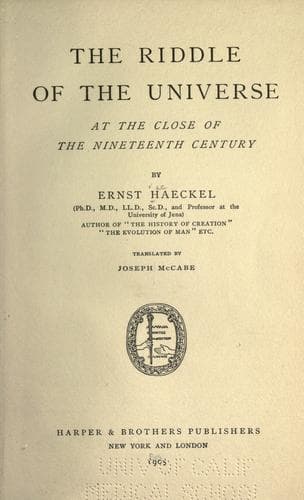
The Riddle of the Universe at the close of the nineteenth centuryHaeckel, Ernst
Religion
The Riddle of the Universe at the close of the nineteenth century
Haeckel, Ernst
Evolution; Monism; Religion and science; Soul
The existence of ether (or cosmic ether) as a real element is a
_positive fact_, and has been known as such for the last twelve years.
We sometimes read even to-day that ether is a "pure hypothesis";
this erroneous assertion comes not only from uninformed philosophers
and "popular" writers, but even from certain "prudent and exact
physicists." But there would be just as much reason to deny the
existence of ponderable matter. As a matter of fact, there are
metaphysicians who accomplish even this feat, and whose highest wisdom
lies in denying or calling into question the existence of an external
universe; according to them only one real entity exists--their own
precious personality, or, to be more correct, their immortal soul.
Several modern physiologists have embraced this ultra-idealist view,
which is to be found in Descartes, Berkeley, Fichte, and others.
Their "psycho-monism" affirms: "One thing only exists, and that is
my own mind." This audacious spiritualism seems to us to rest on an
erroneous inference from Kant's correct critical theory, that we can
know the outer world only in the phenomenal aspect which is accessible
to our human organs of thought--the brain and the organs of sense. If
by those means we can attain only an imperfect and limited knowledge
of the material world, that is no reason for denying its existence
altogether. In my opinion, the existence of ether is as certain as that
of ponderable matter--as certain as my own existence, as I reflect and
write on it. As we assure ourselves of the existence of ponderable
matter by its mass and weight, by chemical and mechanical experiments,
so we prove that of ether by the experiences and experiments of optics
and electricity.
Although, however, the existence of ether is now regarded as a
positive fact by nearly all physicists, and although many effects of
this remarkable substance are familiar to us through an extensive
experience, especially in the way of optical and electrical experiments,
yet we are still far from being clear and confident as to its real
character. The views of the most eminent physicists, who have made
a special study of it, are extremely divergent; they frequently
contradict each other on the most important points. One is, therefore,
free to choose among the contradictory hypotheses according to one's
knowledge and judgment. I will put in the following eight theses the
view which has approved itself to me after mature reflection on the
subject, though I am no expert in this department:
I. Ether fills the whole of space, in so far as it is not occupied by
ponderable matter, as a _continuous substance_; it fully occupies the
space between the atoms of ponderable matter.
Public-domain text, read in full here on John Shaqi.
Reviews
Reviews
No reviews yet
Be the first to share your thoughts on this work.
Elsewhere in the archive
Join the Discussion
Join the discussion
Sign in to leave a comment or review.
Sign InorCreate an account