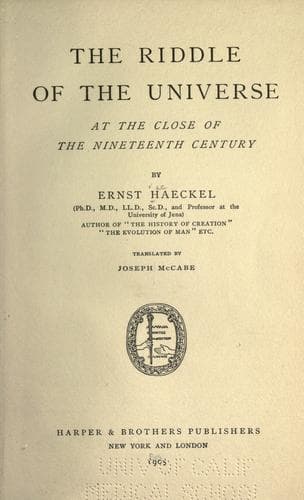
The Riddle of the Universe at the close of the nineteenth centuryHaeckel, Ernst
Religion
The Riddle of the Universe at the close of the nineteenth century
Haeckel, Ernst
Evolution; Monism; Religion and science; Soul
II. Ether has probably no chemical quality, and is not composed of
atoms. If it be supposed that it consists of minute homogeneous atoms
(for instance, indivisible etheric particles of a uniform size), it
must be further supposed that there is something else between these
atoms, either "empty space" or a third, completely unknown medium, a
purely hypothetical "interether"; the question as to the nature of this
brings us back to the original difficulty, and so on _in infinitum_.
III. As the idea of an empty space and an action at a distance is
scarcely possible in the present condition of our knowledge (at least
it does not help to a clear monistic view), I postulate for ether a
special structure which is not atomistic, like that of ponderable
matter, and which may provisionally be called (without further
determination) _etheric_ or _dynamic_ structure.
IV. The consistency of ether is also peculiar, on our hypothesis, and
different from that of ponderable matter. It is neither gaseous, as
some conceive, nor solid, as others suppose; the best idea of it can be
formed by comparison with an extremely attenuated, elastic, and light
jelly.
V. Ether may be called _imponderable_ matter in the sense that we
have no means of determining its weight experimentally. If it really
has weight, as is very probable, it must be so slight as to be far
below the capacity of our most delicate balance. Some physicists have
attempted to determine its weight by the energy of the light-waves, and
have discovered that it is some fifteen trillion times lighter than
atmospheric air; on that hypothesis a sphere of ether of the size of
our earth would weigh at least two hundred and fifty pounds(?).
VI. The etheric consistency may probably (in accordance with the
pyknotic theory) pass into the gaseous state under certain conditions
by progressive condensation, just as a gas may be converted into a
fluid, and ultimately into a solid, by lowering its temperature.
VII. Consequently, these three conditions of matter may be arranged
(and it is a point of great importance in our monistic cosmogony) in a
genetic, continuous order. We may distinguish five stages in it: (1)
the etheric, (2) the gaseous, (3) the fluid, (4) the viscous (in the
living protoplasm), and (5) the solid state.
VIII. Ether is boundless and immeasurable, like the space it occupies.
It is in eternal motion; and this specific movement of ether (it is
immaterial whether we conceive it as vibration, strain, condensation,
etc.), in reciprocal action with mass-movement (or gravitation), is the
ultimate cause of all phenomena.
Public-domain text, read in full here on John Shaqi.
Reviews
Reviews
No reviews yet
Be the first to share your thoughts on this work.
Elsewhere in the archive
Join the Discussion
Join the discussion
Sign in to leave a comment or review.
Sign InorCreate an account