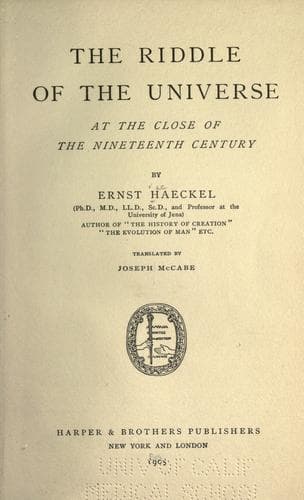
The Riddle of the Universe at the close of the nineteenth centuryHaeckel, Ernst
Religion
The Riddle of the Universe at the close of the nineteenth century
Haeckel, Ernst
Evolution; Monism; Religion and science; Soul
According to this creationist theory, then, God has "made the world
out of nothing." It is supposed that God (a rational, but immaterial,
being) existed by himself for an eternity before he resolved to create
the world. Some supporters of the theory restrict God's creative
function to one single act; they believe that this extramundane God
(the rest of whose life is shrouded in mystery) created the substance
of the world in a single moment, endowed it with the faculty of
the most extensive evolution, and troubled no further about it.
This view may be found, for instance, in the English Deists in many
forms. It approaches very close to our monistic theory of evolution,
only abandoning it in the one instant in which God accomplished the
creation. Other creationists contend that God did not confine himself
to the mere creation of matter, but that he continues to be operative
as the "sustainer and ruler of the world." Different modifications of
this belief are found, some approaching very close to _pantheism_ and
others to complete _theism_. All these and similar forms of belief in
creation are incompatible with the law of the persistence of matter and
force; that law knows nothing of a beginning.
It is interesting to note that E. du Bois-Reymond has identified
himself with this cosmological creationism in his latest speech
(on "Neovitalism," 1894). "It is more consonant with the divine
omnipotence," he says, "to assume that it created the whole material
of the world in one creative act unthinkable ages ago in such
wise that it should be endowed with inviolable laws to control the
origin and the progress of living things--that, for instance, here
on earth rudimentary organisms should arise from which, without
further assistance, the whole of living nature could be evolved, from
a primitive bacillus to the graceful palm-wood, from a primitive
micrococcus to Solomon's lovely wives or to the brain of Newton.
Thus we are content with _one_ creative day, and we derive organic
nature mechanically, without the aid of either old or new vitalism."
Du Bois-Reymond here shows, as in the question of consciousness, the
shallow and illogical character of his monistic thought.
According to another still prevalent theory, which may be called
"ontological creationism," God not only created the world at large,
but also its separate contents. In the Christian world the old Semitic
legend of creation, taken from Genesis, is still very widely accepted;
even among modern scientists it finds an adherent here and there. I
have fully entered into the criticism of it in the first chapter of my
_Natural History of Creation_. The following theories may be enumerated
as the most interesting modifications of this ontological creationism:
Public-domain text, read in full here on John Shaqi.
Reviews
Reviews
No reviews yet
Be the first to share your thoughts on this work.
Elsewhere in the archive
Join the Discussion
Join the discussion
Sign in to leave a comment or review.
Sign InorCreate an account