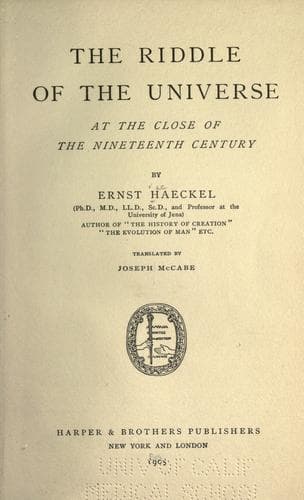
The Riddle of the Universe at the close of the nineteenth centuryHaeckel, Ernst
Religion
The Riddle of the Universe at the close of the nineteenth century
Haeckel, Ernst
Evolution; Monism; Religion and science; Soul
The greatest, vastest, and most difficult of all cosmic problems is
that of the origin and development of the world--the "question of
creation," in a word. Even to the solution of this most difficult
world-riddle the nineteenth century has contributed more than all its
predecessors; in a certain sense, indeed, it has found the solution. We
have at least attained to a clear view of the fact that all the partial
questions of creation are indivisibly connected, that they represent
one single, comprehensive "cosmic problem," and that the key to this
problem is found in the one magic word--evolution. The great questions
of the creation of man, the creation of the animals and plants, the
creation of the earth and the sun, etc., are all parts of the general
question, What is the origin of the whole world? Has it been _created_
by supernatural power, or has it been _evolved_ by a natural process?
What are the causes and the manner of this evolution? If we succeed
in finding the correct answer to one of these questions, we have,
according to our monistic conception of the world, cast a brilliant
light on the solution of them all, and on the entire cosmic problem.
The current opinion as to the origin of the world in earlier ages was
almost a universal belief in creation. This belief has been expressed
in thousands of interesting, more or less fabulous, legends, poems,
cosmogonies, and myths. A few great philosophers were devoid of it,
especially those remarkable free-thinkers of classical antiquity who
first conceived the idea of natural evolution. All the creation-myths,
on the contrary, were of a supernatural, miraculous, and transcendental
character. Incompetent, as it was, to investigate for itself the
nature of the world and its origin by natural causes, the undeveloped
mind naturally had recourse to the idea of miracle. In most of these
creation-myths _anthropism_ was blended with the belief in the
miraculous. The creator was supposed to have constructed the world on a
definite plan, just as man accomplishes his artificial constructions;
the conception of the creator was generally completely anthropomorphic,
a palpable "anthropistic creationism." The "all-mighty maker of heaven
and earth," as he is called in Genesis and the Catechism, is just as
humanly conceived as the modern creator of Agassiz and Reinke, or the
intelligent "engineer" of other recent biologists.
Entering more fully into the notion of creation, we can distinguish
as two entirely different acts the production of the universe as a
whole and the partial production of its various parts, in harmony with
Spinoza's idea of _substance_ (the universe) and _accidents_ (or
_modes_, the individual phenomena of substance). This distinction is of
great importance, because there are many eminent philosophers who admit
the one and reject the other.
Public-domain text, read in full here on John Shaqi.
Reviews
Reviews
No reviews yet
Be the first to share your thoughts on this work.
Elsewhere in the archive
Join the Discussion
Join the discussion
Sign in to leave a comment or review.
Sign InorCreate an account