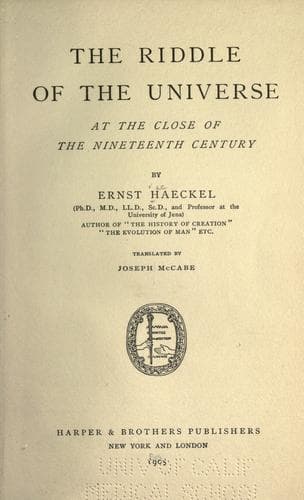
The Riddle of the Universe at the close of the nineteenth centuryHaeckel, Ernst
Religion
The Riddle of the Universe at the close of the nineteenth century
Haeckel, Ernst
Evolution; Monism; Religion and science; Soul
The error of these creation-legends and the cognate belief in miracles
must have been apparent to thoughtful minds at an early period; more
than two thousand years ago we find that many attempts were made
to replace them by a rational theory, and to explain the origin of
the world by natural causes. In the front rank, once more, we must
place the leaders of the Ionic school, with Democritus, Heraclitus,
Empedocles, Aristotle, Lucretius, and other ancient philosophers. The
first imperfect attempts which they made astonish us, in a measure,
by the flashes of mental light in which they anticipate modern ideas.
It must be remembered that classical antiquity had not that solid
groundwork for scientific speculation which has been provided by the
countless observations and experiments of modern scientists. During the
Middle Ages--especially during the domination of the papacy--scientific
work in this direction entirely ceased. The torture and the stake of
the Inquisition insured that an unconditional belief in the Hebrew
mythology should be the final answer to all the questions of creation.
Even the phenomena which led directly to the observation of the _facts_
of evolution--the embryology of the plant and the animal, and of
man--remained unnoticed, or only excited the interest of an occasional
keen observer; but their discoveries were ignored or forgotten.
Moreover, the path to a correct knowledge of natural development was
barred by the dominant theory of preformation, the dogma which held
that the characteristic form and structure of each animal and plant
were already sketched in miniature in the germ (cf. p. 54).
The science which we now call the science of evolution (in the broadest
sense) is, both in its general outline and in its separate parts,
a child of the nineteenth century; it is one of its most momentous
and most brilliant achievements. Almost unknown in the preceding
century, this theory has now become the sure foundation of our whole
world-system. I have treated it exhaustively in my _General Morphology_
(1866), more popularly in my _Natural History of Creation_ (1868), and
in its special application to man in my _Anthropogeny_ (1874). Here I
shall restrict myself to a brief survey of the chief advances which
the science has made in the course of the century. It falls into four
sections, according to the nature of its object; that is, it deals with
the natural origin of (1) the cosmos, (2) the earth, (3) terrestrial
forms of life, and (4) man.
I.--MONISTIC COSMOGONY
Public-domain text, read in full here on John Shaqi.
Reviews
Reviews
No reviews yet
Be the first to share your thoughts on this work.
Elsewhere in the archive
Join the Discussion
Join the discussion
Sign in to leave a comment or review.
Sign InorCreate an account