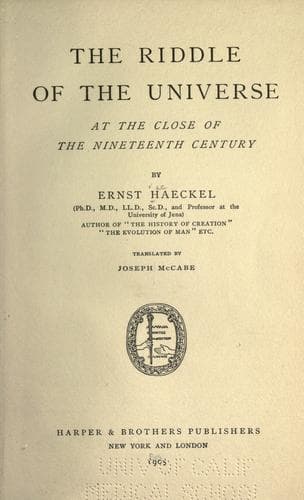
The Riddle of the Universe at the close of the nineteenth centuryHaeckel, Ernst
Religion
The Riddle of the Universe at the close of the nineteenth century
Haeckel, Ernst
Evolution; Monism; Religion and science; Soul
The first attempt to explain the constitution and the mechanical
origin of the world in a simple manner by "Newtonian laws"--that is,
by mathematical and physical laws--was made by Immanuel Kant in the
famous work of his youth (1755), _General History of the Earth and
Theory of the Heavens_. Unfortunately, this distinguished and daring
work remained almost unknown for ninety years; it was only disinterred
in 1845 by Alexander Humboldt in the first volume of his _Cosmos_. In
the mean time the great French mathematician, Pierre Laplace, had
arrived independently at similar views to those of Kant, and he gave
them a mathematical foundation in his _Exposition du Système du Monde_
(1796). His chief work, the _Mécanique Céleste_, appeared a hundred
years ago. The analogous features of the cosmogony of Kant and Laplace
consist, as is well known, in a mechanical explanation of the movements
of the planets, and the conclusion which is drawn therefrom, that all
the cosmic bodies were formed originally by a condensation of rotating
nebulous spheres. This "nebular hypothesis" has been much improved
and supplemented since, but it is still the best of all the attempts
to explain the origin of the world on monistic and mechanical lines.
It has recently been strongly confirmed and enlarged by the theory
that this cosmogonic process did not simply take place once, but is
periodically repeated. While new cosmic bodies arise and develop out
of rotating masses of nebula in some parts of the universe, in other
parts old, extinct, frigid suns come into collision, and are once more
reduced by the heat generated to the condition of nebulæ.
Nearly all the older and the more recent cosmogonies, including most
of those which were inspired by Kant and Laplace, started from the
popular idea that the world had had a beginning. Hence, according to
a widespread version of the nebular hypothesis, "in the beginning"
was made a vast nebula of infinitely attenuated and light material,
and at a certain moment ("countless ages ago") a movement of rotation
was imparted to this mass. Given this "first beginning" of the
cosmogonic movement, it is easy, on mechanical principles, to deduce
and mathematically establish the further phenomena of the formation of
the cosmic bodies, the separation of the planets, and so forth. This
first "origin of movement" is Du Bois-Reymond's second "world-enigma";
he regards it as transcendental. Many other scientists and philosophers
are equally helpless before this difficulty; they resign themselves to
the notion that we have here a primary "supernatural impetus" to the
scheme of things, a "miracle."
Public-domain text, read in full here on John Shaqi.
Reviews
Reviews
No reviews yet
Be the first to share your thoughts on this work.
Elsewhere in the archive
Join the Discussion
Join the discussion
Sign in to leave a comment or review.
Sign InorCreate an account