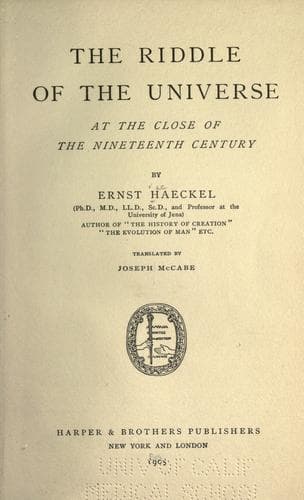
The Riddle of the Universe at the close of the nineteenth centuryHaeckel, Ernst
Religion
The Riddle of the Universe at the close of the nineteenth century
Haeckel, Ernst
Evolution; Monism; Religion and science; Soul
The representatives of the theory of entropy are quite correct as long
as they confine themselves to distinct processes, in which, _under
certain conditions_, the latent heat cannot be reconverted into work.
Thus, for instance, in the steam-engine the heat can only be converted
into mechanical work when it passes from a warmer body (steam) into a
cooler (water); the process cannot be reversed. In the world at large,
however, quite other conditions obtain--conditions which permit the
reconversion of latent heat into mechanical work. For instance, in the
collision of two heavenly bodies, which rush towards each other at
inconceivable speed, enormous quantities of heat are liberated, while
the pulverized masses are hurled and scattered about space. The eternal
drama begins afresh--the rotating mass, the condensation of its parts,
the formation of new meteorites, their combination into larger bodies,
and so on.
II.--MONISTIC GEOGENY
The history of the earth, of which we are now going to make a brief
survey, is only a minute section of the history of the cosmos. Like
the latter, it has been the object of philosophic speculation and
mythological fantasy for many thousand years. Its true scientific
study, however, is much younger; it belongs, for the most part, to
the nineteenth century. The fact that the earth is a planet revolving
round the sun was determined by the system of Copernicus (1543);
Galilei, Kepler, and other great astronomers, mathematically determined
its distance from the sun, the laws of its motion, and so forth.
Kant and Laplace indicated, in their cosmogony, the way in which the
earth had been developed from the parent sun. But the later history
of the earth, the formation of its crust, the origin of its seas and
continents, its mountains and deserts, was rarely made the subject
of serious scientific research in the eighteenth century, and in the
first two decades of the nineteenth. As a rule, men were satisfied with
unreliable conjectures or with the traditional story of creation; once
more the Mosaic legend barred the way to an independent investigation.
Public-domain text, read in full here on John Shaqi.
Reviews
Reviews
No reviews yet
Be the first to share your thoughts on this work.
Elsewhere in the archive
Join the Discussion
Join the discussion
Sign in to leave a comment or review.
Sign InorCreate an account