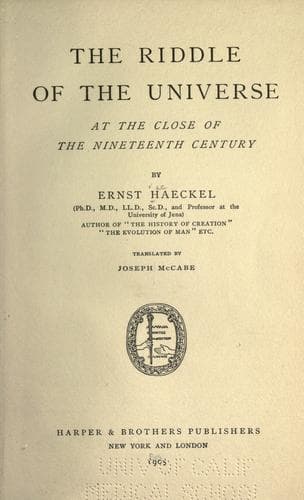
The Riddle of the Universe at the close of the nineteenth centuryHaeckel, Ernst
Religion
The Riddle of the Universe at the close of the nineteenth century
Haeckel, Ernst
Evolution; Monism; Religion and science; Soul
The able founder of the mechanical theory of heat (1850), Clausius,
embodied the momentous contents of this important theory in two theses.
The first runs: "The energy of the universe is constant"--that is
one-half of our law of substance, the principle of energy (_vide_ p.
230). The second thesis is: "The energy of the universe tends towards
a maximum." In my opinion this second assertion is just as erroneous
as the first is true. In the theory of Clausius the entire energy of
the universe is of two kinds, one of which (heat of the higher degree,
mechanical, electrical, chemical energy, etc.) is partly convertible
into work, but the other is not; the latter energy, already converted
into heat and distributed in the cooler masses, is irrevocably lost as
far as any further work is concerned. Clausius calls this unconsumed
energy, which is no longer available for mechanical work, _entropy_
(that is, force that is directed _inward_); it is continually
increasing at the cost of the other half. As, therefore, the mechanical
energy of the universe is daily being transformed into heat, and this
cannot be reconverted into mechanical force, the sum of heat and energy
in the universe must continually tend to be reduced and dissipated. All
difference of temperature must ultimately disappear, and the completely
latent heat must be equally distributed through one inert mass of
motionless matter. All organic life and movement must cease when this
maximum of _entropy_ has been reached. That would be a real "end of the
world."
If this theory of entropy were true, we should have a "beginning"
corresponding to this assumed "end" of the world--a minimum of
entropy, in which the differences in temperature of the various parts
of the cosmos would be at a maximum. Both ideas are quite untenable
in the light of our monistic and consistent theory of the eternal
cosmogenetic process; both contradict the law of substance. There is
neither beginning nor end of the world. The universe is infinite, and
eternally in motion; the conversion of kinetic into potential energy,
and _vicissim_, goes on uninterruptedly; and the sum of this actual and
potential energy remains constant. The second thesis of the mechanical
theory of heat contradicts the first, and so must be rejected.
Public-domain text, read in full here on John Shaqi.
Reviews
Reviews
No reviews yet
Be the first to share your thoughts on this work.
Elsewhere in the archive
Join the Discussion
Join the discussion
Sign in to leave a comment or review.
Sign InorCreate an account