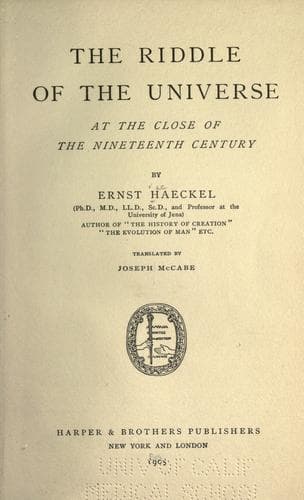
The Riddle of the Universe at the close of the nineteenth centuryHaeckel, Ernst
Religion
The Riddle of the Universe at the close of the nineteenth century
Haeckel, Ernst
Evolution; Monism; Religion and science; Soul
The first division of the history of the earth must be a separation
of inorganic and organic geogeny; the latter begins with the first
appearance of living things on our planet. The earlier section, the
inorganic history of the earth, ran much the same course as that of the
other planets of our system. They were all cast off as rings of nebula
at the equator of the rotating solar mass, and gradually condensed
into independent bodies. After cooling down a little, the glowing ball
of the earth was formed out of the gaseous mass, and eventually, as
the heat continued to radiate out into space, there was formed at its
surface the thin solid crust on which we live. When the temperature at
the surface had gone down to a certain point, the water descended upon
it from the environing clouds of steam, and thus the first condition
was secured for the rise of organic life. Many million years--certainly
more than a hundred--have passed since this important process of
the formation of water took place, introducing the third section of
cosmogony, which we call _biogeny_.
III.--MONISTIC BIOGENY
The third phase of the evolution of the world opens with the advent of
organisms on our planet, and continues uninterrupted from that point
until the present day. The great problems which this most interesting
part of the earth's history suggests to us were still thought insoluble
at the beginning of the nineteenth century, or, at least, so difficult
that their solution seemed to be extremely remote. Now, at the close of
the century, we can affirm with legitimate pride that they have been
substantially solved by modern biology and its theory of transformism;
indeed, many of the phenomena of the organic world are now interpreted
on physical principles as completely as the familiar physical phenomena
of inorganic nature. The merit of making the first important step
in this difficult path and of pointing out the way to the monistic
solution of all the problems of biology must be accorded to the great
French scientist, Jean Lamarck; it was in 1809, the year of the
birth of Charles Darwin, that he published his famous _Philosophie
Zoologique_. In this original work not only is a splendid effort made
to interpret all the phenomena of organic life from a monistic and
physical point of view, but the path is opened which alone leads to
the solution of the greatest enigma of this branch of science--the
problem of the natural origin of organic species. Lamarck, who had an
equally extensive empirical acquaintance with zoology and botany, drew
the first sketch of the theory of descent; he showed that all the
countless members of the plant and animal kingdoms have arisen by slow
transformation from simple, common ancestral types, and that it is the
gradual modification of forms by _adaptation_, in reciprocal action
with _heredity_, which has brought about this secular metamorphosis.
Public-domain text, read in full here on John Shaqi.
Reviews
Reviews
No reviews yet
Be the first to share your thoughts on this work.
Elsewhere in the archive
Join the Discussion
Join the discussion
Sign in to leave a comment or review.
Sign InorCreate an account