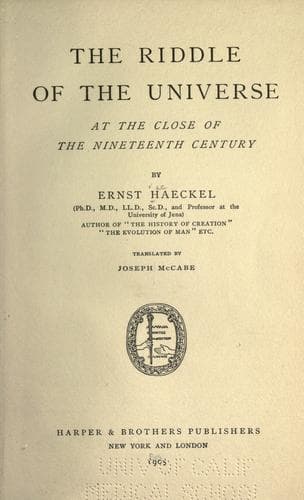
The Riddle of the Universe at the close of the nineteenth centuryHaeckel, Ernst
Religion
The Riddle of the Universe at the close of the nineteenth century
Haeckel, Ernst
Evolution; Monism; Religion and science; Soul
I have fully appreciated the merit of Lamarck in the fifth chapter, and
of Darwin in the sixth and seventh chapters, of the _Natural History
of Creation_. Darwin, fifty years afterwards, not only gave a solid
foundation to all the essential parts of the theory of descent, but he
filled up the _lacunae_ of Lamarck's work by his theory of selection.
Darwin reaped abundantly the success that Lamarck had never seen,
with all his merit. His epoch-making work on _The Origin of Species
by Natural Selection_ has transformed modern biology from its very
foundations, in the course of the last forty years, and has raised it
to a stage of development that yields to no other science in existence.
Darwin is _the Copernicus of the organic world_, as I said in 1868, and
E. du Bois-Reymond repeated fifteen years afterwards.[27]
IV.--MONISTIC ANTHROPOGENY
The fourth and last phase of the world's history must be for us men
that latest period of time which has witnessed the development of our
own race. Lamarck (1809) had already recognized that this evolution is
only rationally conceivable as the outcome of a natural process, by
"descent from the apes," our next of kin among the mammals. Huxley then
proved, in his famous essay on _The Place of Man in Nature_, that this
momentous thesis is an inevitable consequence of the theory of descent,
and is thoroughly established by the facts of anatomy, embryology, and
palæontology. He considered this "question of all questions" to be
substantially answered. Darwin followed with a brilliant discussion
of the question under many aspects in his _Descent of Man_ (1871).
I had myself devoted a special chapter to this important problem of
the science of evolution in my _General Morphology_ (1866). In 1874 I
published my _Anthropogeny_, which contains the first attempt to trace
the descent of man through the entire chain of his ancestry right up to
the earliest archigonous monera; the attempt was based equally on the
three great "documents" of evolutionary science--anatomy, embryology,
and palæontology. The progress we have made in anthropogenetic research
during the last few years is described in the paper which I read on
"Our Present Knowledge of the Origin of Man" at the International
Congress of Zoologists at Cambridge in 1898.[28]
CHAPTER XIV
THE UNITY OF NATURE
The Monism of the Cosmos--Essential Unity of Organic
and Inorganic Nature--Carbon-Theory--The Hypothesis of
Abiogenesis--Mechanical and Purposive Causes--Mechanicism and
Teleology in Kant's Works--Design in the Organic and Inorganic
Worlds--Vitalism--Neovitalism--Dysteleology (the Moral of the
Rudimentary Organs)--Absence of Design in, and Imperfection of,
Nature--Telic Action in Organized Bodies--Its Absence in Ontogeny
and Phylogeny--The Platonist "Ideas"--No Moral Order Discoverable
in the History of the Organic World, of the Vertebrates, or of the
Human Race--Prevision--Design and Chance
Public-domain text, read in full here on John Shaqi.
Reviews
Reviews
No reviews yet
Be the first to share your thoughts on this work.
Elsewhere in the archive
Join the Discussion
Join the discussion
Sign in to leave a comment or review.
Sign InorCreate an account