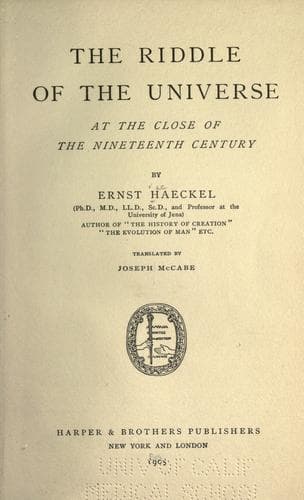
The Riddle of the Universe at the close of the nineteenth centuryHaeckel, Ernst
Religion
The Riddle of the Universe at the close of the nineteenth century
Haeckel, Ernst
Evolution; Monism; Religion and science; Soul
Baer, however, did not attain to a deeper knowledge of this great
genetic truth and a clearer insight into the real efficient causes of
organic evolution, because his attention was exclusively given to
one half of evolutionary science, the science of the evolution of the
individual, embryology, or, in a wider sense, _ontogeny_. The other
half, the science of the evolution of species, _phylogeny_, was not yet
in existence, although Lamarck had already pointed out the way to it in
1809. When it was established by Darwin in 1859, the aged Baer was no
longer in a position to appreciate it; the fruitless struggle which he
led against the theory of selection clearly proved that he understood
neither its real meaning nor its philosophic importance. Teleological
and, subsequently, theological speculations had incapacitated the
ageing scientist from appreciating this greatest reform of biology. The
teleological observations which he published against it in his _Species
and Studies_ in his eighty-fourth year are mere repetitions of errors
which the teleology of the dualists has opposed to the mechanical or
monistic system for more than two thousand years. The "telic idea"
which, according to Baer, controls the entire evolution of the animal
from the ovum, is only another expression for the eternal "idea" of
Plato and the _entelecheia_ of his pupil Aristotle.
Our modern biogeny gives a purely physiological explanation of the
facts of embryology, in assigning the functions of heredity and
adaptation as their causes. The great biogenetic law, which Baer
failed to appreciate, reveals the intimate causal connection between
the _ontogenesis_ of the individual and the _phylogenesis_ of its
ancestors; the former seems to be a recapitulation of the latter.
Nowhere, however, in the evolution of animals and plants do we find any
trace of design, but merely the inevitable outcome of the struggle for
existence, the blind controller, instead of the provident God, that
effects the changes of organic forms by a mutual action of the laws of
heredity and adaptation. And there is no more trace of "design" in the
embryology of the individual plant, animal, or man. This _ontogeny_
is but a brief epitome of _phylogeny_, an abbreviated and condensed
recapitulation of it, determined by the physiological laws of heredity.
Baer ended the preface to his classical _Evolution of Animals_ (1828)
with these words: "The palm will be awarded to the fortunate scientist
who succeeds in reducing the constructive forces of the animal body
to the general forces or life-processes of the entire world. The tree
has not yet been planted which is to make his cradle." The great
embryologist erred once more. That very year, 1828, witnessed the
arrival of Charles Darwin at Cambridge University (for the purpose of
studying theology!)--the "fortunate scientist" who richly earned the
palm thirty years afterwards by his theory of selection.
Public-domain text, read in full here on John Shaqi.
Reviews
Reviews
No reviews yet
Be the first to share your thoughts on this work.
Elsewhere in the archive
Join the Discussion
Join the discussion
Sign in to leave a comment or review.
Sign InorCreate an account