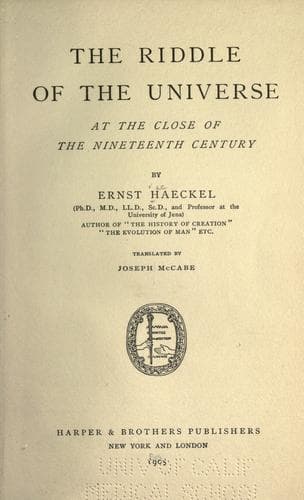
The Riddle of the Universe at the close of the nineteenth centuryHaeckel, Ernst
Religion
The Riddle of the Universe at the close of the nineteenth century
Haeckel, Ernst
Evolution; Monism; Religion and science; Soul
One group of philosophers affirms, in accordance with its teleological
conception, that the whole cosmos is an orderly system, in which every
phenomenon has its aim and purpose; there is no such thing as chance.
The other group, holding a mechanical theory, expresses itself thus:
The development of the universe is a monistic mechanical process, in
which we discover no aim or purpose whatever; what we call design in
the organic world is a special result of biological agencies; neither
in the evolution of the heavenly bodies nor in that of the crust of
our earth do we find any trace of a controlling purpose--all is the
result of chance. Each party is right--according to its definition of
chance. The general law of causality, taken in conjunction with the law
of substance, teaches us that every phenomenon has a mechanical cause;
in this sense there is no such thing as chance. Yet it is not only
lawful, but necessary, to retain the term for the purpose of expressing
the simultaneous occurrence of two phenomena, which are not causally
related to each other, but of which each has its own mechanical cause,
independent of that of the other. Everybody knows that chance, in its
monistic sense, plays an important part in the life of man and in the
universe at large. That, however, does not prevent us from recognizing
in each "chance" event, as we do in the evolution of the entire
cosmos, the universal sovereignty of nature's supreme law, _the law of
substance_.
CHAPTER XV
GOD AND THE WORLD
The Idea of God in General--Antithesis of God and the World; the
Supernatural and Nature--Theism and Pantheism--Chief Forms of
Theism--Polytheism--Triplotheism--Amphitheism--Monotheism--Religious
Statistics--Naturalistic Monotheism--Solarism--Anthropistic
Monotheism--The Three Great Mediterranean
Religions--Mosaism--Christianity--The Cult of the Madonna and
the Saints--Papal Polytheism--Islam--Mixotheism--Nature of
Theism--An Extra-mundane and Anthropomorphic God; a Gaseous
Vertebrate--Pantheism--Intramundane God (Nature)--The Hylozoism
of the Ionic Monists (Anaximander)--Conflict of Pantheism and
Christianity--Spinoza--Modern Monism--Atheism
For thousands of years humanity has placed the last and supreme basis
of all phenomena in an efficient cause, to which it gives the title of
God (_deus_, _theos_). Like all general ideas, this notion of God has
undergone a series of remarkable modifications and transformations in
the course of the evolution of reason. Indeed, it may be said that no
other idea has had so many metamorphoses; for no other belief affects
in so high a degree the chief objects of the mind and of rational
science, as well as the deepest interests of the emotion and poetic
fancy of the believer.
Public-domain text, read in full here on John Shaqi.
Reviews
Reviews
No reviews yet
Be the first to share your thoughts on this work.
Elsewhere in the archive
Join the Discussion
Join the discussion
Sign in to leave a comment or review.
Sign InorCreate an account