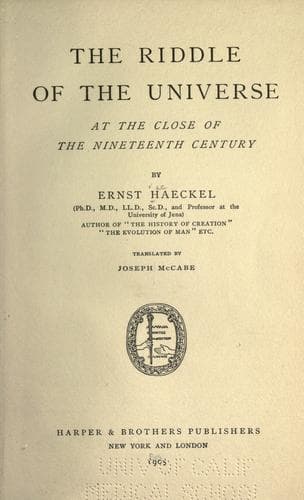
The Riddle of the Universe at the close of the nineteenth centuryHaeckel, Ernst
Religion
The Riddle of the Universe at the close of the nineteenth century
Haeckel, Ernst
Evolution; Monism; Religion and science; Soul
A comparative criticism of the many different forms of the idea of God
would be extremely interesting and instructive; but we have not space
for it in the present work. We must be content with a passing glance
at the most important forms of the belief and their relation to the
modern thought that has been evoked by a sound study of nature. For
further information on this interesting question the reader would do
well to consult the distinguished work of Adalbert Svoboda, _Forms of
Faith_ (1897).
When we pass over the finer shades and the variegated clothing of
the God-idea and confine our attention to its chief element, we can
distribute all the different presentations of it in two groups--the
_theistic_ and _pantheistic_ group. The latter is closely connected
with the monistic, or rational, view of things, and the former is
associated with dualism and mysticism.
I.--THEISM
In this view God is distinct from, and opposed to, the world as its
creator, sustainer, and ruler. He is always conceived in a more or
less human form, as an organism which thinks and acts like a man--only
on a much higher scale. This anthropomorphic God, polyphyletically
evolved by the different races, assumes an infinity of shapes in their
imagination, from fetichism to the refined monotheistic religions
of the present day. The chief forms of theism are polytheism,
triplotheism, amphitheism, and monotheism.
The polytheist peoples the world with a variety of gods and goddesses,
which enter into its machinery more or less independently. _Fetichism_
sees such subordinate deities in the lifeless body of nature, in rocks,
in water, in the air, in human productions of every kind (pictures,
statues, etc.). _Demonism_ sees gods in living organisms of every
species--trees, animals, and men. This kind of polytheism is found in
innumerable forms even in the lowest tribes. It reaches the highest
stage in Hellenic polytheism, in the myths of ancient Greece, which
still furnish the finest images to the modern poet and artist. At a
much lower stage we have Catholic polytheism, in which innumerable
"saints" (many of them of very equivocal repute) are venerated as
subordinate divinities, and prayed to to exert their mediation with the
supreme divinity.
Public-domain text, read in full here on John Shaqi.
Reviews
Reviews
No reviews yet
Be the first to share your thoughts on this work.
Elsewhere in the archive
Join the Discussion
Join the discussion
Sign in to leave a comment or review.
Sign InorCreate an account