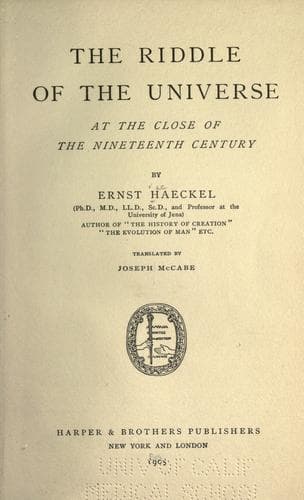
The Riddle of the Universe at the close of the nineteenth centuryHaeckel, Ernst
Religion
The Riddle of the Universe at the close of the nineteenth century
Haeckel, Ernst
Evolution; Monism; Religion and science; Soul
The monotheism which Moses endeavored to establish in the worship
of Jehovah, and which the prophets--the philosophers of the Hebrew
race--afterwards developed with great success, had at first to sustain
a long and severe struggle with the dominant polytheism which was
in possession. Jehovah, or Yahveh, was originally derived from the
heaven-god, which, under the title of Moloch or Baal, was one of
the most popular of the Oriental deities (the Sethos or Typhon of
the Egyptians, and the Saturn or Cronos of the Greeks). There were,
however, other gods in great favor with the Jewish people, and so the
struggle with "idolatry" continued. Still, Jehovah was, in principle,
the only God, explicitly claiming, in the first precept of the
decalogue: "I am the Lord thy God; thou shalt have no other gods beside
me."
Christian monotheism shared the fate of its mother, Mosaism; it was
generally only monotheistic in theory, while it degenerated practically
into every kind of polytheism. In point of fact, monotheism was
logically abandoned in the very dogma of the Trinity, which was adopted
as an indispensable foundation of the Christian religion. The three
persons, which are distinguished as Father, Son, and Holy Ghost, are
three distinct individuals (and, indeed, anthropomorphic persons), just
as truly as the three Indian deities of the Trimurti (Brahma, Vishnu,
and Shiva) or the Trinity of the ancient Hebrews (Anu, Bel, and Aa).
Moreover, in the most widely distributed form of Christianity the
"virgin" mother of Christ plays an important part as a fourth deity;
in many Catholic countries she is practically taken to be much more
powerful and influential than the three male persons of the celestial
administration. The cult of the madonna has been developed to such an
extent in these countries that we may oppose it to the usual masculine
form of monotheism as one of a feminine type. The "Queen of Heaven"
becomes so prominent, as is seen in so many pictures and legends of the
madonna, that the three male persons practically disappear.
In addition, the imagination of the pious Christian soon came to
increase this celestial administration by a numerous company of
"saints" of all kinds, and bands of musical angels, who should see
that "eternal life" should not prove too dull. The popes--the greatest
charlatans that any religion ever produced--have constantly studied to
increase this band of celestial satellites by repeated canonizations.
This curious company received its most interesting acquisition in 1870,
when the Vatican Council pronounced the popes, as the vicars of Christ,
to be infallible, and thus raised them to a divine dignity. When we add
the "personal Devil" that they acknowledge, and the "bad angels" who
form his court, we have in modern Catholicism, still the most extensive
branch of Christianity, a rich and variegated polytheism that dwarfs
the Olympic family of the Greeks.
Public-domain text, read in full here on John Shaqi.
Reviews
Reviews
No reviews yet
Be the first to share your thoughts on this work.
Elsewhere in the archive
Join the Discussion
Join the discussion
Sign in to leave a comment or review.
Sign InorCreate an account