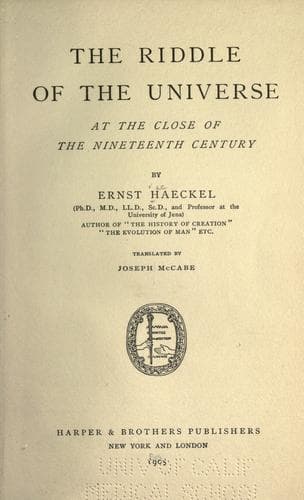
The Riddle of the Universe at the close of the nineteenth centuryHaeckel, Ernst
Religion
The Riddle of the Universe at the close of the nineteenth century
Haeckel, Ernst
Evolution; Monism; Religion and science; Soul
fact, the sun-worshippers attained, thousands of years ago, a higher
intellectual and moral standard than most of the other theists. When
I was in Bombay, in 1881, I watched with the greatest sympathy the
elevating rites of the pious Parsees, who, standing on the sea-shore,
or kneeling on their prayer-rugs, offered their devotion to the sun at
its rise and setting.[31]
Moon-worship (lunarism and selenotheism) is of much less importance
than sun-worship. There are a few uncivilized races that have adored
the moon as their only deity, but it has generally been associated with
a worship of the stars and the sun.
The humanization of God, or the idea that the "Supreme Being" feels,
thinks, and acts like man (though in a higher degree), has played a
most important part, as _anthropomorphic monotheism_, in the history
of civilization. The most prominent in this respect are the three
great religions of the Mediterranean peoples--the old Mosaic religion,
the intermediate Christian religion, and the younger Mohammedanism.
These three great Mediterranean religions, all three arising on the
east coast of the most interesting of all seas, and originating in an
imaginative enthusiast of the Semitic race, are intimately connected,
not only by this external circumstance of an analogous origin, but by
many common features of their internal contents. Just as Christianity
borrowed a good deal of its mythology directly from ancient Judaism, so
Islam has inherited much from both its predecessors. All the three were
originally monotheistic; all three were subsequently overlaid with a
great variety of polytheistic features, in proportion as they extended,
first along the coast of the Mediterranean with its heterogeneous
population, and eventually into every part of the world.
The Hebrew monotheism, as it was founded by Moses (about 1600 B.C.), is
usually regarded as the ancient faith which has been of the greatest
importance in the ethical and religious development of humanity.
This high historical appreciation is certainly valid in the sense
that the two other world-conquering Mediterranean religions issued
from it; Christ was just as truly a pupil of Moses as Mohammed was
afterwards of Christ. So also the New Testament, which has become the
foundation of the belief of the highest civilized nations in the short
space of nineteen hundred years, rests on the venerable basis of the
Old Testament. The Bible, which the two compose, has had a greater
influence and a wider circulation than any other book in the world.
Even to-day the Bible--in spite of its curious mingling of the best and
the worst elements--is in a certain sense the "book of books." Yet when
we make an impartial and unprejudiced study of this notable historical
source, we find it very different in several important respects from
the popular impression. Here again modern criticism and history have
come to certain conclusions which destroy the prevalent tradition in
its very foundations.
Public-domain text, read in full here on John Shaqi.
Reviews
Reviews
No reviews yet
Be the first to share your thoughts on this work.
Elsewhere in the archive
Join the Discussion
Join the discussion
Sign in to leave a comment or review.
Sign InorCreate an account